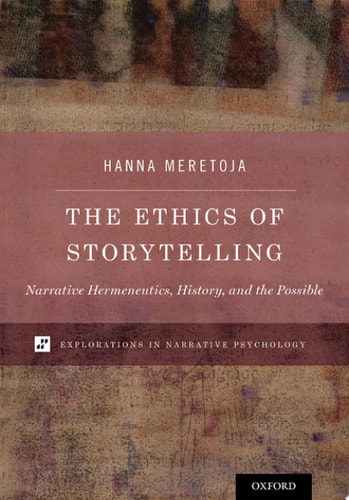
The Ethics of Storytelling: Narrative Hermeneutics, History, and the Possible
0
0
As an Amazon Associate and affiliate partner, Menrva Books earns from qualifying purchases. Learn more
Author Description
Against the backdrop of the polarized debate on the ethical significance of storytelling, Hanna Meretoja's The Ethics of Storytelling: Narrative Hermeneutics, History, and the Possible develops a nuanced framework for exploring the ethical complexity of the roles narratives play in our lives. Focusing on how narratives enlarge and diminish the spaces of possibilities in which we act, think, and re-imagine the world together with others, this book proposes a theoretical-analytical framework for engaging with both the ethical potential and risks of storytelling. Further, it elaborates a narrative hermeneutics that treats narratives as culturally mediated practices of (re)interpreting experiences and articulates how narratives can be oppressive, empowering, or both. It also argues that the relationship between narrative unconscious and narrative imagination shapes our sense of the possible.In her book, Meretoja develops a hermeneutic narrative ethics that differentiates between six dimensions of the ethical potential of storytelling: the power of narratives to cultivate our sense of the possible; to contribute to individual and cultural self-understanding; to enable understanding other lives non-subsumptively in their singularity; to transform the narrative in-betweens that bind people together; to develop our perspective-awareness and capacity for perspective-taking; and to function as a form of ethical inquiry. This book addresses our implication in violent histories and argues that it is as dialogic storytellers, fundamentally vulnerable and dependent on one another, that we become who we are: both as individuals and communities.The Ethics of Storytelling seamlessly incorporates narrative ethics, literary narrative studies, narrative psychology, narrative philosophy, and cultural memory studies. It contributes to contemporary interdisciplinary narrative studies by developing narrative hermeneutics as a philosophically rigorous, historically sensitive, and analytical
Menrva's Summary
THE THESIS
This book investigates the ethical dimensions of storytelling by examining how narratives function as both tools for empowerment and instruments of oppression. Hanna Meretoja, a scholar in narrative studies, constructs a theoretical framework that bridges narrative psychology, philosophy, and cultural memory. By analyzing the interplay between narrative imagination and the unconscious, the author argues that our capacity to envision possibilities is fundamentally shaped by the stories we inhabit and construct.
THE SCOPE MAP
What You Will Find
- A six-dimensional framework for evaluating the ethical potential of narratives.
- An analysis of narrative hermeneutics as a practice of interpreting experience.
- An exploration of how individuals and communities are implicated in violent histories.
Scope Limits
- The text does not provide a practical guide for creative writing or therapeutic intervention.
- It focuses primarily on theoretical and philosophical inquiry rather than empirical psychological data.
THE AUTHORITY PERSPECTIVE
Scholars in the field of narrative studies recognize this work as a rigorous interdisciplinary contribution that successfully synthesizes philosophy and literary theory. Readers frequently note the academic density of the prose, which is intended for those familiar with hermeneutic and philosophical discourse.
Page Count:
366
Publication Date:
2017-01-01
Publisher:
Oxford University Press
ISBN-10:
0190649380
ISBN-13:
9780190649388
Philosophy
English & College Success
Literary theory
Mind & Body
English
Narrative Psychology
Ethics
Hermeneutics
Community Tags
Similar Books