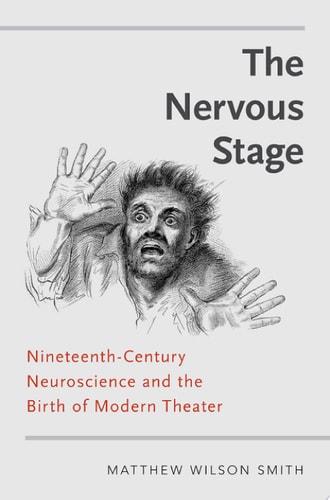
The Nervous Stage: Nineteenth-century Neuroscience and the Birth of Modern Theatre
0
0
As an Amazon Associate and affiliate partner, Menrva Books earns from qualifying purchases. Learn more
Author Description
Nineteenth-century investigations into the nervous system produced extraordinary discoveries that changed ways of thinking far beyond the scientific community. Over the course of the century, scientists began to conceive of the subject not principally as soul, mind, or even brain, but instead as a complex of organically interacting mechanisms, many of them operating more or less autonomously and unconsciously. Meanwhile, theatrical works of the time by Shelley, Wagner, Dickens, Buchner, Zola, and Strindberg, sought to play directly on the nerves of the spectators through non-representational means, comprising a coherent genre Matthew Wilson Smith has dubbed the "theaters of sensation." The Nervous Stage examines the relations between theatrical practices and the scientific study of the nervous system, arguing that to a significant degree, modern theater emerged out of the interaction between these two apparently disparate fields. In six chapters, The Nervous Stage makes three fundamental contributions to scholarship on comparative literature, specifically in the areas of drama/performance, cognitive literary studies, and the beginnings of global modernism. Through a series of revisionist readings of specific theatrical works and artists, Smith demonstrates that a number of literary texts were deeply engaged in dialogue with the neurological sciences of their period, and that an appreciation of this dialogue helps us better to understand their significance for their own historical period as well as for our own. Furthermore, it argues that a number of lesser-known works--ranging from certain "closet dramas" such as Shelley's The Cenci to popular melodramas such as Augustin Daly's Under the Gaslight--had much greater cultural significance than has been acknowledged heretofore.
Menrva's Summary
THE THESIS
This book investigates how nineteenth-century neurological discoveries fundamentally shaped the development of modern theatrical practices. Matthew Wilson Smith, a scholar of drama and performance, utilizes a cross-disciplinary framework to argue that the emergence of modern theater was inextricably linked to the scientific conceptualization of the nervous system as an autonomous, mechanical complex. By analyzing the intersection of scientific inquiry and dramatic art, Smith posits that theatrical works of the era were not merely reflective of their time but were active participants in a dialogue with emerging neurological sciences.
THE SCOPE MAP
What You Will Find
- Analysis of the "theaters of sensation" as a coherent genre
- Revisionist readings of works by Shelley, Wagner, Dickens, Buchner, Zola, and Strindberg
- Examination of the cultural significance of popular melodramas and closet dramas
- Integration of cognitive literary studies with historical performance analysis
Scope Limits
- The study is restricted to the nineteenth-century timeframe
- The analysis focuses primarily on Western theatrical traditions and their specific engagement with neurological discourse
THE AUTHORITY PERSPECTIVE
Scholars in the fields of performance studies and cognitive literary criticism recognize this work as a significant contribution to understanding the historical roots of modernism. Readers frequently note the academic density of the prose, which serves as a foundational text for those examining the intersection of science and the arts.
Page Count:
237
Publication Date:
2017-01-01
Publisher:
Oxford University Press
ISBN-10:
0190644109
ISBN-13:
9780190644109
History
Science
Theatre studies
Modernism
Neuroscience
Drama
Neurosciences
Theatre
Psychobiology
Theater
Literary Criticism
Gesture
Humanities
Community Tags
Similar Books