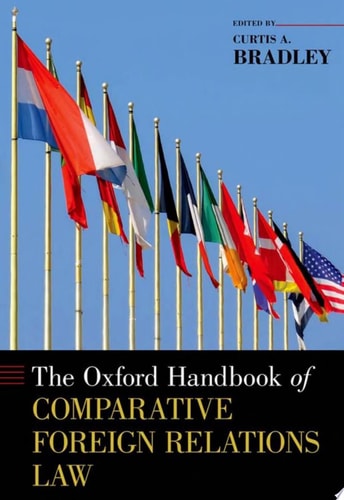
The Oxford Handbook of Comparative Foreign Relations Law
0
0
As an Amazon Associate and affiliate partner, Menrva Books earns from qualifying purchases. Learn more
Author Description
This Oxford Handbook ambitiously seeks to lay the groundwork for the relatively new field of comparative foreign relations law. Comparative foreign relations law compares and contrasts how nations, and also supranational entities (for example, the European Union), structure their decisions about matters such as entering into and exiting from international agreements, engaging with international institutions, and using military force, as well as how they incorporate treaties and customary international law into their domestic legal systems. The legal materials that make up a nation's foreign relations law can include constitutional law, statutory law, administrative law, and judicial precedent, among other areas. This book consists of 46 chapters, written by leading authors from around the world. Some of the chapters are empirically focused, others are theoretical, and still others contain in-depth case studies. In addition to being an invaluable resource for scholars working in this area, the book should be of interest to a wide range of lawyers, judges, and law students. Foreign relations law issues are addressed regularly by lawyers working in foreign ministries, and globalization has meant that domestic judges, too, are increasingly confronted by them. In addition, private lawyers who work on matters that extend beyond their home countries often are required to navigate issues of foreign relations law. An increasing number of law school courses in comparative foreign relations law are also now being developed, making this volume an important resource for students as well. Comparative foreign relations law is a newly emerging field of study and teaching, and this volume is likely to become a key reference work as the field continues to develop.
Menrva's Summary
THE THESIS
This volume investigates the structural and procedural mechanisms by which diverse nations and supranational entities manage foreign relations and integrate international law into domestic legal systems. Edited by Curtis A. Bradley, the text compiles contributions from global legal scholars to establish a foundational framework for the emerging field of comparative foreign relations law. It synthesizes constitutional, statutory, and administrative perspectives to analyze how different jurisdictions approach treaty-making, international institutional engagement, and the deployment of military force.
THE SCOPE MAP
What You Will Find
- Comparative analysis of 46 distinct chapters covering global legal systems
- Examination of treaty incorporation and customary international law
- Theoretical, empirical, and case-study based methodologies
Scope Limits
- Does not provide a singular, unified global legal code
- Does not cover every individual nation-state in exhaustive detail
THE AUTHORITY PERSPECTIVE
Legal scholars and practitioners identify this volume as a primary reference for the nascent field of comparative foreign relations law. The text is noted for its academic rigor and its utility for judges, foreign ministry officials, and law students navigating the complexities of international legal integration.
Page Count:
992
Publication Date:
2019-01-01
Publisher:
Oxford University Press
ISBN-10:
0190653345
ISBN-13:
9780190653347
Reference
Comparative Law
International Law
Law
Community Tags
Similar Books