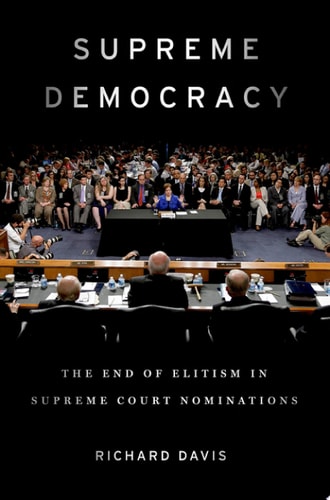
Supreme Democracy: The End of Elitism in Supreme Court Nominations
0
0
As an Amazon Associate and affiliate partner, Menrva Books earns from qualifying purchases. Learn more
Author Description
In the nineteenth and early twentieth centuries, Supreme Court nominations were driven by presidents, senators, and some legal community elites. Many nominations were quick processes with little Senate deliberation, minimal publicity and almost no public involvement. Today, however, confirmation takes 81 days on average-Justice Antonin Scalia's former seat has already taken much longer to fill-and it is typically a media spectacle. How did the Supreme Court nomination process become so public and so nakedly political? What forces led to the current high-stakes status of the process? How could we implement reforms to improve the process? In Supreme Democracy: The End of Elitism in the Supreme Court Nominations, Richard Davis, an eminent scholar of American politics and the courts, traces the history of nominations from the early republic to the present. He examines the component parts of the nomination process one by one: the presidential nomination stage, the confirmation management process, the role of the Senate Judiciary Committee, and the increasing involvement over time of interest groups, the news media, and public opinion. The most dramatic development, however, has been the democratization of politics. Davis delves into the constitutional underpinnings of the nomination process and its traditional form before describing a more democratic process that has emerged in the past half century. He details the struggle over image-making between supporters and opponents intended to influence the news media and public opinion. Most importantly, he provides a thorough examination of whether or not increasing democracy always produces better governance, and a better Court. Not only an authoritative analysis of the Supreme Court nomination process from the founding era to the present, Supreme Democracy will be an essential guide to all of the protracted nomination battles yet to come.
Menrva's Summary
THE THESIS
This book investigates the historical transformation of the Supreme Court nomination process from an elite-driven procedure to a highly public, politicized spectacle. Richard W. Davis, a scholar of American politics, utilizes historical records and political analysis to argue that the democratization of the process has fundamentally altered the relationship between the judiciary, the media, and the public. He examines the shift from minimal Senate deliberation to the current high-stakes environment, questioning whether increased public involvement results in improved governance or a more effective Court.
THE SCOPE MAP
What You Will Find
- Historical analysis of nomination procedures from the early republic to the present day.
- Examination of the roles played by the Senate Judiciary Committee, interest groups, and the news media.
- Assessment of the impact of public opinion on presidential and senatorial decision-making.
Scope Limits
- The text does not provide a comprehensive legal biography of every Supreme Court justice.
- It does not offer a predictive model for future specific judicial rulings.
THE AUTHORITY PERSPECTIVE
Experts recognize this work as a thorough examination of the institutional evolution of the judicial confirmation process. Readers frequently note the academic rigor and the clear, structured approach Davis takes in documenting the shift toward a more democratic, albeit more contentious, political landscape.
Page Count:
287
Publication Date:
2017-01-01
Publisher:
Oxford University Press
ISBN-10:
0190656980
ISBN-13:
9780190656980
Law
Supreme Court
Public Policy
Professional Career & Trade
American History
United States
Government
Community Tags
Similar Books