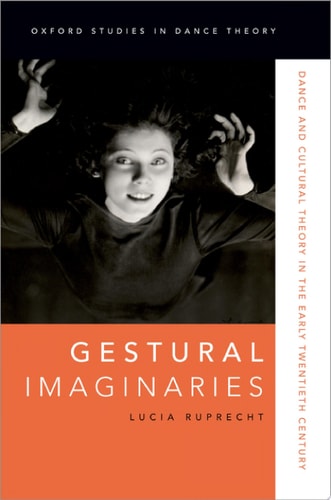
Gestural Imaginaries: Dance and Cultural Theory in the Early Twentieth Century (Oxford Studies in Dance Theory)
0
0
As an Amazon Associate and affiliate partner, Menrva Books earns from qualifying purchases. Learn more
Author Description
Gestural Imaginaries: Dance and Cultural Theory in the Early Twentieth Century offers a new interpretation of European modernist dance by addressing it as guiding medium in a vibrant field of gestural culture that ranged across art and philosophy. Taking further Cornelius Castoriadis's concept of the social imaginary, it explores this imaginary's embodied forms. Close readings of dances, photographs, and literary texts are juxtaposed with discussions of gestural theory by thinkers including Walter Benjamin, Sigmund Freud, and Aby Warburg. Choreographic gesture is defined as a force of intermittency that creates a new theoretical status of dance. Author Lucia Ruprecht shows how this also bears on contemporary theory. She shifts emphasis from Giorgio Agamben's preoccupation with gestural mediality to Jacques Rancière's multiplicity of proliferating, singular gestures, arguing for their ethical and political relevance. Mobilizing dance history and movement analysis, Ruprecht highlights the critical impact of works by choreographers such as Vaslav Nijinsky, Jo Mihaly, and Alexander and Clotilde Sakharoff. She also offers choreographic readings of Franz Kafka and Alfred Döblin. Gestural Imaginaries proposes that modernist dance conducts a gestural revolution which enacts but also exceeds the insights of past and present cultural theory. It makes a case for archive-based, cross-medial, and critically informed dance studies, transnational German studies, and the theoretical potential of performance itself.
Menrva's Summary
THE THESIS
This book investigates how early twentieth-century modernist dance functioned as a primary medium for shaping the gestural culture of its time, bridging the gap between artistic practice and philosophical inquiry. Author Lucia Ruprecht, a scholar in German and performance studies, utilizes a framework rooted in Cornelius Castoriadis's concept of the social imaginary to analyze how dance embodies cultural shifts. By juxtaposing choreographic works with the writings of thinkers like Walter Benjamin and Aby Warburg, she argues that dance gestures possess a unique, intermittent force that challenges and expands existing theoretical paradigms. The text posits that these movements are not merely aesthetic, but carry significant ethical and political weight that remains relevant to contemporary critical theory.
THE SCOPE MAP
What You Will Find
- Analysis of modernist dance works by choreographers such as Vaslav Nijinsky, Jo Mihaly, and the Sakharoffs.
- Theoretical engagement with the works of Walter Benjamin, Sigmund Freud, Aby Warburg, and Jacques Rancière.
- Cross-medial readings that connect dance, photography, and literature, including texts by Franz Kafka and Alfred Döblin.
- A methodology that combines archival research with movement analysis to define gesture as a force of intermittency.
Scope Limits
- The study focuses primarily on European modernist contexts and does not provide a comprehensive global history of dance.
- It does not offer a general introduction to dance history, assuming a reader already familiar with basic performance theory and modernist philosophy.
THE AUTHORITY PERSPECTIVE
Scholars in the field of dance studies recognize this work as a rigorous contribution to the intersection of performance and critical theory. Readers frequently note the academic density of the prose, which is intended for an audience well-versed in continental philosophy and modernist aesthetics.
Page Count:
349
Publication Date:
2019-01-01
Publisher:
Oxford University Press
ISBN-10:
0190659408
ISBN-13:
9780190659400
Philosophy
Modernism
Cultural Theory
Dance
Theatre
European History
Dance Studies
Theatre History
Ballet
Arts europe
Choreography
Modern Dance
Performance Studies
Humanities
Community Tags
Similar Books