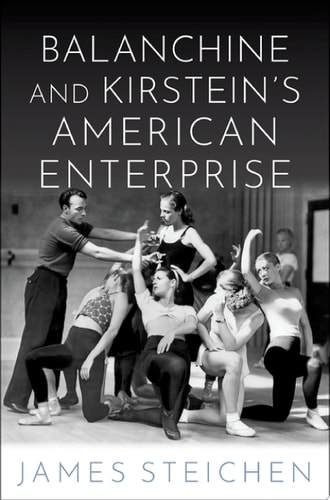
Balanchine and Kirstein's American Enterprise
0
0
As an Amazon Associate and affiliate partner, Menrva Books earns from qualifying purchases. Learn more
Author Description
In 1933 choreographer George Balanchine and impresario Lincoln Kirstein embarked on an elusive quest to found a ballet company and school in the United States. Though their efforts would eventually result in the creation of the New York City Ballet and the School of American Ballet, the first decade of their collaborative efforts was anything but assured. Tracing the tangled histories of two of the most important figures in twentieth-century dance, Balanchine and Kirstein's American Enterprise offers a fresh perspective on a pivotal period in cultural history. Deeply researched using sources only made available in recent years, the book challenges the mythologies surrounding the early years of the Balanchine-Kirstein enterprise. It also reveals the full extent of Kirstein's essential role and offers reconstructive analysis of lost works, as well as new and surprising details regarding some of Balanchine's most iconic ballets, including Serenade, Apollo, and Concerto Barocco. This history involved artists including Richard Rodgers, Martha Graham, George Gershwin, Katherine Dunham, Vera Zorina, and Igor Stravinsky, as well as dozens of lesser known players whose contributions have yet to be fully acknowledged. Capturing the full sweep of Balanchine and Kirstein's collaborative work across multiple genres and institutions, this book reveals their partnership in all of its exciting and ungainly complexity, showing how the 1930s Balanchine was not the artist that he would eventually become, and how the same was true of the institutions that he and Kirstein jointly created.
Menrva's Summary
THE THESIS
This book investigates the formative decade of the partnership between George Balanchine and Lincoln Kirstein to determine how their early, often uncertain efforts established the foundation for American ballet. James Steichen, a scholar of dance and cultural history, utilizes recently released archival materials to reconstruct the development of the New York City Ballet and the School of American Ballet. By examining the collaborative dynamics between the choreographer and the impresario, the author challenges established myths and provides a nuanced account of their institutional and artistic evolution during the 1930s.
THE SCOPE MAP
What You Will Find
- Detailed analysis of the 1930s collaborative period between Balanchine and Kirstein
- Reconstructive studies of lost dance works and early versions of iconic ballets
- Examination of the roles played by collaborators such as Igor Stravinsky, Martha Graham, and Richard Rodgers
- Archival research into the administrative and artistic struggles of early American ballet institutions
Scope Limits
- The text focuses primarily on the 1930s rather than the entirety of the subjects' later careers
- It does not provide a comprehensive biography of either man outside the context of their joint enterprise
THE AUTHORITY PERSPECTIVE
Experts highlight this work as a significant contribution to dance history that successfully demystifies the early years of a major cultural institution. Readers frequently note the depth of the archival research and the clarity with which the author navigates the complex professional relationship between the two subjects.
Page Count:
312
Publication Date:
2018-01-01
Publisher:
Oxford University Press
ISBN-10:
0190607432
ISBN-13:
9780190607432
Non-Fiction
Biography
Choreography
Dance
Humanities
Cultural History
Dance History
Ballet
Community Tags
Other Editions(3)


Similar Books



Reader Comments
Share Your Thoughts
No comments yet. Be the first to share your thoughts!