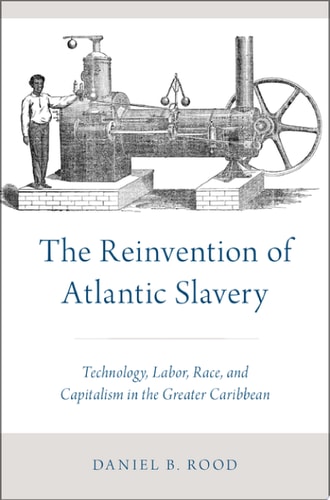
The Reinvention of Atlantic Slavery: Technology, Labor, Race, and Capitalism in the Greater Caribbean
0
0
As an Amazon Associate and affiliate partner, Menrva Books earns from qualifying purchases. Learn more
Author Description
The period of the "second slavery" was marked by geographic expansion of zones of slavery into the Upper US South, Cuba and Brazil and chronological expansion into the industrial age.As The Reinvention of Atlantic Slavery shows, ambitious planters throughout the Greater Caribbean hired a transnational group of chemists, engineers, and other "plantation experts" to assist them in adapting industrial technologies to suit their "tropical" needs and increase profitability. Not only were technologies reinvented so as to keep manufacturing processes local but slaveholders' adaptation of new racial ideologies also shaped their particular usage of new machines. Finally, these businessmen forged a new set of relationships with one another in order to sidestep the financial dominance of Great Britain and the northeastern United States. In addition to promoting new forms of mechanization, the technical experts depended on the know-how of slaves alongside whom they worked. Bondspeople with industrial craft skills played key roles in the development of new production processes and technologies like sugar mills. While the very existence of such skilled slaves contradicted prevailing racial ideologies and allowed black people to wield power in their own interest, their contributions grew the slave economies of Cuba, Brazil, and the Upper South. Together reform-minded planters, technical experts, and enslaved people modernized sugar plantations in Louisiana and Cuba; brought together rural Virginia wheat planters and industrial flour-millers in Richmond with the coffee-planting system of southeastern Brazil; and enabled engineers and iron-makers in Virginia to collaborate with railroad and sugar entrepreneurs in Cuba.Through his examination of the creation of these industrial bodies of knowledge, Daniel B. Rood demonstrates the deepening dependence of the Atlantic economy on forced labor after a few revolutionary decades in which it seemed the institution of slavery might be destroyed.
Menrva's Summary
THE THESIS
This book investigates how the expansion of slavery in the 19th-century Greater Caribbean was inextricably linked to the adoption of industrial technology and the creation of new transnational networks of expertise. Daniel B. Rood, a historian specializing in the Atlantic world, utilizes archival research from Cuba, Brazil, and the United States to argue that the so-called 'second slavery' was not a regressive institution but a modern, technologically driven economic system. He demonstrates how planters, engineers, and enslaved laborers collaborated to adapt industrial machinery to plantation environments, thereby reinforcing the profitability and longevity of forced labor in the industrial age.
THE SCOPE MAP
What You Will Find
- Analysis of the 'second slavery' period in the 19th century
- Examination of transnational networks involving chemists, engineers, and planters
- Case studies of sugar mills in Cuba and Louisiana and flour mills in Virginia
- Exploration of the role of skilled enslaved laborers in technological innovation
Scope Limits
- The study focuses primarily on the Greater Caribbean and its connections to the US South and Brazil
- It does not provide a comprehensive history of the entire Atlantic slave trade, focusing instead on the industrialization of plantation labor
THE AUTHORITY PERSPECTIVE
Scholars frequently cite this work for its contribution to the understanding of how slavery adapted to the industrial revolution. Experts highlight the text as a significant intervention in economic history that challenges the assumption that slavery and industrialization were mutually exclusive systems.
Page Count:
272
Publication Date:
2017-01-01
Publisher:
Oxford University Press
ISBN-10:
0190655283
ISBN-13:
9780190655280
History
Labor history
Technology
Modern History
West Indies
Plantations
Atlantic History
Economics history
Caribbean Area
American History
Economic History
United States
Community Tags
Similar Books