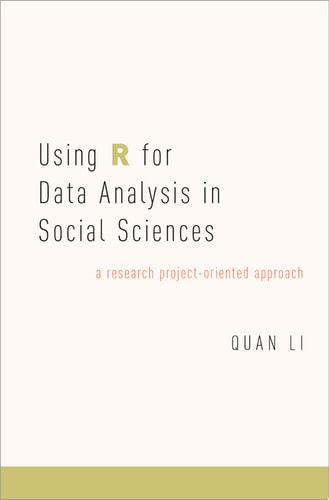
Using R for Data Analysis in Social Sciences
0
0
As an Amazon Associate and affiliate partner, Menrva Books earns from qualifying purchases. Learn more
Author Description
Statistical Analysis Is Common In The Social Sciences, And Among The More Popular Programs Is R. This Book Provides A Foundation For Undergraduate And Graduate Students In The Social Sciences On How To Use R To Manage, Visualize, And Analyze Data. The Focus Is On How To Address Substantive Questions With Data Analysis And Replicate Published Findings. Using R For Data Analysis In Social Sciences Adopts A Minimalist Approach And Covers Only The Most Important Functions And Skills In R To Conduct Reproducible Research. It Emphasizes The Practical Needs Of Students Using R By Showing How To Import, Inspect, And Manage Data, Understand The Logic Of Statistical Inference, Visualize Data And Findings Via Histograms, Boxplots, Scatterplots, And Diagnostic Plots, And Analyze Data Using One-sample T-test, Difference-of-means Test, Covariance, Correlation, Ordinary Least Squares (ols) Regression, And Model Assumption Diagnostics. It Also Demonstrates How To Replicate The Findings In Published Journal Articles And Diagnose Model Assumption Violations. Because The Book Integrates R Programming, The Logic And Steps Of Statistical Inference, And The Process Of Empirical Social Scientific Research In A Highly Accessible And Structured Fashion, It Is Appropriate For Any Introductory Course On R, Data Analysis, And Empirical Social-scientific Research.
Menrva's Summary
THE THESIS
This book investigates how students in the social sciences can effectively utilize the R programming language to manage, visualize, and analyze empirical data. Author Quan Li provides a structured, minimalist framework designed for undergraduate and graduate students who need to bridge the gap between statistical theory and practical research application. By focusing on essential functions and the replication of published findings, the text serves as a bridge for those conducting reproducible social scientific research.
THE SCOPE MAP
What You Will Find
- Data management techniques including importing, inspecting, and cleaning datasets.
- Visualization methods such as histograms, boxplots, scatterplots, and diagnostic plots.
- Statistical methodologies including t-tests, correlation, covariance, and Ordinary Least Squares (OLS) regression.
- Practical exercises focused on replicating findings from peer-reviewed journal articles.
Scope Limits
- The text does not cover advanced machine learning algorithms or complex Bayesian modeling techniques.
- It does not provide an exhaustive reference for every R package, focusing instead on a minimalist core set of functions.
THE AUTHORITY PERSPECTIVE
Instructors and students frequently highlight the book's accessibility and its focus on practical, reproducible research workflows. It is widely regarded as a functional introductory text for those seeking to apply R to specific social science research questions.
Page Count:
224
Publication Date:
2018-01-01
Publisher:
Oxford University Press
ISBN-10:
0190656239
ISBN-13:
9780190656232
Social Science
Statistics
Research Methods
Academic
Programming
Data Analysis
Community Tags
Similar Books