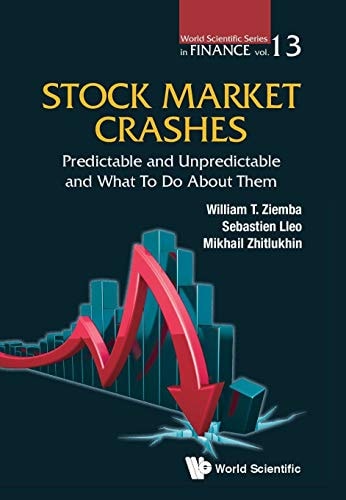
Stock Market Crashes: Predictable and Unpredictable and What to Do About Them
0
0
As an Amazon Associate and affiliate partner, Menrva Books earns from qualifying purchases. Learn more
Author Description
This book presents studies of stock market crashes big and small that occur from bubbles bursting or other reasons. By a bubble we mean that prices are rising just because they are rising and that prices exceed fundamental values. A bubble can be a large rise in prices followed by a steep fall. The focus is on determining if a bubble actually exists, on models to predict stock market declines in bubble-like markets and exit strategies from these bubble-like markets. We list historical great bubbles of various markets over hundreds of years. We present four models that have been successful in predicting large stock market declines of ten percent plus that average about minus twenty-five percent. The bond stock earnings yield difference model was based on the 1987 US crash where the S&P 500 futures fell 29% in one day. The model is based on earnings yields relative to interest rates. When interest rates become too high relative to earnings, there almost always is a decline in four to twelve months. The initial out of sample test was on the Japanese stock market from 1948-88. There all twelve danger signals produced correct decline signals. But there were eight other ten percent plus declines that occurred for other reasons. Then the model called the 1990 Japan huge -56% decline. We show various later applications of the model to US stock declines such as in 2000 and 2007 and to the Chinese stock market. We also compare the model with high price earnings decline predictions over a sixty year period in the US. We show that over twenty year periods that have high returns they all start with low price earnings ratios and end with high ratios. High price earnings models have predictive value and the BSEYD models predict even better.
Menrva's Summary
THE THESIS
This book investigates the mechanisms behind stock market bubbles and crashes to determine if they can be predicted and mitigated through specific financial modeling. The authors, Mikhail Zhitlukhin, Sebastien Lleo, and William T. Ziemba, leverage their expertise in quantitative finance to analyze historical market data and bubble phenomena. They present a rigorous framework centered on the bond stock earnings yield difference (BSEYD) model, evaluating its efficacy in forecasting significant market declines across various global indices and time periods.
THE SCOPE MAP
What You Will Find
- Historical analysis of major market bubbles spanning several centuries.
- Detailed methodology for the bond stock earnings yield difference (BSEYD) model.
- Comparative study of high price-earnings ratio models versus interest rate-based indicators.
- Quantitative evidence from US, Japanese, and Chinese market crashes.
THE AUTHORITY PERSPECTIVE
The text provides a dense, technical examination of market volatility that is best suited for readers with a background in financial theory or quantitative analysis. Its focus on empirical model testing and historical application offers a structured, clinical approach to understanding the mechanics of market corrections.
Page Count:
308
Publication Date:
2019-01-01
Publisher:
World Scientific Singapore Pte Ltd
ISBN-10:
0000987727
ISBN-13:
9780000987723
Business
Economics
Stock Market
Investing
Stocks
Finance
Community Tags
Similar Books