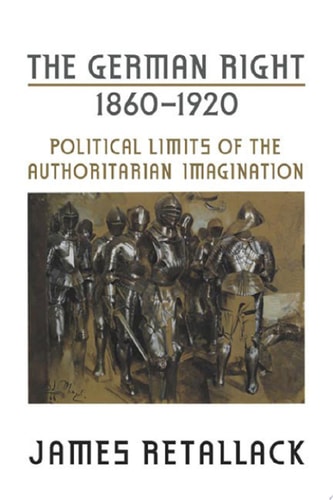
The German Right, 1860-1920
0
0
As an Amazon Associate and affiliate partner, Menrva Books earns from qualifying purchases. Learn more
Author Description
Before the rise of Hitler and the Nazis, Germany was undergoing convulsive socioeconomic and political change. With unification as a nation state under Bismarck in 1871, Germany experienced the advent of mass politics, based on the principle of one man, one vote. The dynamic, diverse political culture that emerged challenged the adaptability of the 'interlocking directorate of the Right.' To serve as a bulwark of the authoritarian state, the Right needed to exploit traditional sources of power while mobilizing new political recruits, but until Emperor Wilhelm II's abdication in 1918 these aims could not easily be reconciled. In The German Right, 1860-1920, James Retallack examines how the authoritarian imagination inspired the Right and how political pragmatism constrained it. He explores the Right's regional and ideological diversity, and refuses to privilege the 1890s as the tipping point when the traditional politics of notables gave way to mass politics. Retallack also challenges the assumption that, if Imperial Germany was modern, it could not also have been authoritarian. Written with clear, persuasive prose, this wide-ranging analysis draws together threads of reasoning from German and Anglo-American scholars over the past 30 years and points the way for future research into unexplored areas.
Menrva's Summary
THE THESIS
The German Right grappled with the tension between traditional power structures and the demands of mass politics in a rapidly modernizing nation. James Retallack, drawing on extensive scholarship, examines the period from 1860 to 1920, a time of profound socioeconomic and political transformation in Germany, culminating in the abdication of Emperor Wilhelm II. The book investigates how the authoritarian imagination shaped the Right's ideology while political pragmatism dictated its actions. Retallack explores the diverse regional and ideological factions within the Right, challenging the notion that the 1890s marked a definitive shift from notable politics to mass politics, and questioning the assumption that modernity and authoritarianism were mutually exclusive in Imperial Germany.
THE SCOPE MAP
- Analysis of the German Right's political strategies and ideological evolution between 1860 and 1920.
- Exploration of the impact of German unification under Bismarck and the advent of mass politics.
- Examination of the challenges faced by the 'interlocking directorate of the Right' in adapting to new political realities.
- Discussion of the reconciliation of traditional power sources with the mobilization of new political recruits.
- Investigation into the regional and ideological diversity within the German Right.
- Challenge to the idea of the 1890s as the sole tipping point for the transition to mass politics.
- Re-evaluation of the relationship between Imperial Germany's modernity and its authoritarian characteristics.
- Synthesis of German and Anglo-American scholarship on the subject over the past 30 years.
THE AUTHORITY PERSPECTIVE
James Retallack's analysis is characterized by its clear and persuasive prose, synthesizing decades of scholarship on the German Right. The book is noted for its wide-ranging scope and its contribution to future research by highlighting unexplored areas. It challenges established assumptions about the transition to mass politics and the nature of authoritarianism in modern Germany. The work is positioned as a significant contribution to the understanding of late 19th and early 20th-century German political history.
Page Count:
416
Publication Date:
2006-12-15
Publisher:
University of Toronto Press
ISBN-10:
1442659181
ISBN-13:
9781442659186
History
Non-Fiction
Politics
European History
Community Tags
Similar Books