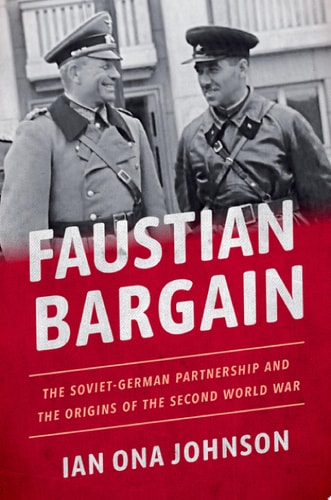
Faustian Bargain: The Soviet-German Partnership and the Origins of the Second World War
0
0
As an Amazon Associate and affiliate partner, Menrva Books earns from qualifying purchases. Learn more
Author Description
MP3 CD Format When Nazi Germany invaded Poland on September 1, 1939, launching World War Two, its military might was literally overwhelming. The Luftwaffe bombed towns and cities across the country; fifty divisions of the Wehrmacht crossed the border. Yet only two decades earlier, at the end of World War One, Germany had been an utterly and abjectly defeated military power. Foreign troops occupied its industrial heartland and the Treaty of Versailles had reduced its vaunted army to a fraction of its size, banning it from developing new military technologies. When Hitler came to power in 1933, these strictures were still in effect. By 1939, however, he had at his disposal a fighting force of 4.2 million men, armed with the most advanced weapons in the world. How could this seemingly miraculous turnaround have happened? As Ian Ona Johnson establishes beyond question in Faustian Bargain, the answer lies in Soviet Russia. Beginning in the years immediately after the First World War and continuing for more than a decade, the German military and the Soviet Union, despite having been bitter enemies, entered into a partnership designed to overturn the order in Europe. Centering on economic and military cooperation, the arrangement led to the establishment of a network of military bases and industrial facilities on Soviet soil, away from the oversight established by Versailles. Through their alliance, which continued for over a decade, Germany gained the space to rebuild its army. In return, the Soviet Union received vital military, technological, and economic assistance. Both became military powers capable of mass destruction--one that was eventually directed against the other. Drawing from archives in five countries, including new collections of declassified Russian documents, Faustian Bargain offers the most authoritative exploration to date of this secret pact and its cataclysmic results.
Menrva's Summary
THE THESIS
This work investigates how a clandestine military and economic partnership between the Soviet Union and Germany facilitated the rapid rearmament of the Wehrmacht, effectively undermining the post-World War I international order. Ian Ona Johnson, a historian specializing in military and diplomatic history, utilizes a vast array of primary source materials to reconstruct this secret collaboration. By examining the period between the Treaty of Versailles and the outbreak of World War II, the author argues that the Soviet Union provided the essential testing grounds and industrial support necessary for Germany to circumvent international military restrictions. The text posits that this cooperation was a critical, yet often overlooked, catalyst for the subsequent global conflict.
THE SCOPE MAP
What You Will Find
- Detailed analysis of the secret military bases and industrial facilities established by Germany on Soviet soil.
- Examination of the technological and economic exchange protocols between the two nations.
- Extensive use of declassified Russian archives and multi-national diplomatic records.
Scope Limits
- The narrative focuses primarily on the military and strategic partnership rather than the internal domestic politics of the Soviet Union or Germany.
- The book does not provide a comprehensive military history of the entire Second World War, concentrating instead on the pre-war period of rearmament.
THE AUTHORITY PERSPECTIVE
Historians and military scholars recognize this text as a significant contribution to the understanding of interwar diplomacy and the origins of the Second World War. Readers frequently note the academic rigor and the depth of archival research presented throughout the chapters.
Page Count:
368
Publication Date:
2021-01-01
Publisher:
Oxford University Press
ISBN-10:
0190675179
ISBN-13:
9780190675172
History
Military History
World War
Germany
International relations
Europe
European History
Eastern Europe
Russia
Soviet Union
Modern History
Engineering
World Civilization
Community Tags
Similar Books