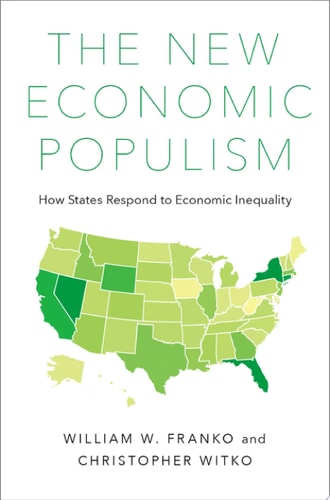
The New Economic Populism: How States Respond to Economic Inequality
0
0
As an Amazon Associate and affiliate partner, Menrva Books earns from qualifying purchases. Learn more
Author Description
Donald Trump's 2016 victory shocked the world, but his appeals to the economic discontent of the white working class should not be so surprising, as stagnant wages for the many have been matched with skyrocketing incomes for the few. Though Trump received high levels of support from the white working class, once in office, the newly elected billionaire president appointed a cabinet with a net worth greater than one-third of American households combined. Furthermore, he pursued traditionally conservative tax, welfare state and regulatory policies, which are likely to make economic disparities worse. Nevertheless, income inequality has grown over the last few decades almost regardless of who is elected to the presidency and congress. There is a growing consensus among scholars that one of the biggest drivers of income inequality in the United States is government activity (or inactivity). Just as the New Deal and Great Society programs played a key role in leveling income distribution from the 1930s through the 1970s, federal policy since then has contributed to expanding inequality. Growing inequality bolsters the resources of the wealthy leading to greater influence over policy, and it contributes to partisan polarization. Both prevent the passage of policy to address inequality, creating a continuous feedback loop of growing inequality. The authors of this book argue that it is therefore misguided to look to the federal government, as citizens have tended to do since the New Deal, to lead on economic policy to "fix" inequality. In fact, they argue that throughout American history, during periods of rapid economic change the federal government has been stymied by the federal institutional design created by the Constitution. The winners of economic change have taken advantage of veto points to prevent change that would address the problems experienced by the losers of major economic change. Even the New Deal, in many ways the model of federal policy activism, was lar
Menrva's Summary
THE THESIS
This book investigates why the United States federal government consistently fails to address rising economic inequality despite public demand for intervention. Authors Christopher Witko and William W. Franko, both scholars of political science and public policy, analyze the structural constraints of the American constitutional system. They argue that the federal government is inherently designed to favor the status quo, creating a feedback loop where economic winners use institutional veto points to block redistributive policies that would otherwise mitigate inequality.
THE SCOPE MAP
What You Will Find
- An analysis of the relationship between government policy and income distribution from the 1930s to the present.
- A framework explaining how institutional design and veto points prevent federal legislative action.
- Examination of the political influence exerted by the wealthy on policy outcomes.
Scope Limits
- The text focuses primarily on federal-level institutional constraints rather than local or state-level policy variations.
- It does not provide a comprehensive history of all economic policy, but rather focuses on the mechanisms of inequality-related legislation.
THE AUTHORITY PERSPECTIVE
Experts recognize this work as a significant contribution to the study of political economy and the limitations of federal policy activism. Readers frequently note the academic rigor of the prose and the clarity with which the authors explain complex institutional barriers to reform.
Page Count:
246
Publication Date:
2017-01-01
Publisher:
Oxford University Press
ISBN-10:
0190671033
ISBN-13:
9780190671037
Economics
Public Policy
American History
American Government
Sociology
Community Tags
Similar Books







Reader Comments
Share Your Thoughts
No comments yet. Be the first to share your thoughts!