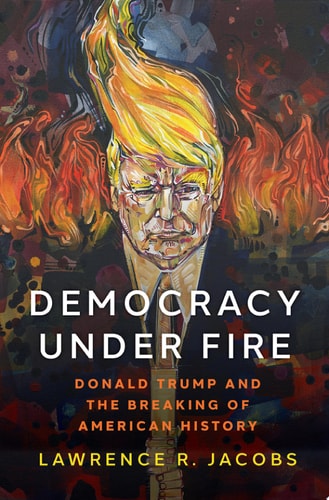
Democracy under Fire: The Rise of Extremists and the Hostile Takeover of the Republican Party
0
0
As an Amazon Associate and affiliate partner, Menrva Books earns from qualifying purchases. Learn more
Author Description
Donald Trump's presidency offered Americans a dire warning regarding the vulnerabilities in their democracy, but the threat is broader and deeper-and looms still."January 6th was a disgrace," Senate Republican Leader Mitch McConnell solemnly intoned at the end of Donald Trump's second impeachment trial on February 13, 2021. As to the culprit, Senator McConnell declared that "there is no question that President Donald Trump is practically and morally responsible." Before Trump even ran for President, his disdain for the rules, procedures, and norms of American democracy and the US Constitution was well-known and led prominent Republicans to repudiate him as "unfit" for the GOP nomination. Given the clear-eyed assessment of candidate Trump, why did the Republican Party nominate him as its presidential candidate in 2016 and then stand by him during the next four years? Much of the attention paid to Trump's rise to power has focused on his corrosive personality and divisive style of governing. But he alone is not the problem. The vulnerability is much broader and deeper. The ascendance of Trump is the culmination of nearly 250 years of political reforms that gradually ceded party nominations to small cliques of ideologically-motivated party activists, interest groups, and donors. Trump's rise is not an aberration but a predictable outcome of trends deeply rooted in American history but which accelerated in the last few decades.In Democracy under Fire, Lawrence Jacobs provides a highly engaging, if disturbing, history of political reforms since the late-eighteenth century that over time dangerously weakened democracy, widened political inequality as well as racial disparities, and rewarded toxic political polarization. Jacobs' searing indictment of political reformers concludes with recommendations to restrain the unbridled ambition of politicians who thrive on division and instead generate broad citizen engagement with tangible policy making.
Menrva's Summary
THE THESIS
This book investigates the structural vulnerabilities within the American political system that facilitated the rise of extremist figures and the transformation of the Republican Party. Lawrence R. Jacobs, a professor and political analyst, utilizes historical analysis and political science frameworks to argue that the current state of American politics is not an isolated incident but the result of long-term institutional reforms. He contends that the shift of nomination power toward ideologically driven activists and donors has systematically undermined democratic norms and exacerbated political inequality.
THE SCOPE MAP
What You Will Find
- A historical analysis of American political reforms spanning from the late eighteenth century to the present.
- An examination of the mechanisms that shifted party power from broad coalitions to narrow interest groups.
- A critique of how institutional changes have fueled racial disparities and toxic polarization.
Scope Limits
- The analysis focuses primarily on the internal mechanics of the Republican Party rather than a comprehensive study of all political parties.
- The text does not provide a detailed biography of Donald Trump, focusing instead on the systemic conditions that allowed his rise.
THE AUTHORITY PERSPECTIVE
Experts and political observers recognize this work as a rigorous examination of the institutional decay within American political parties. Readers frequently note the academic density of the prose and the author's methodical approach to connecting historical policy shifts to contemporary political crises.
Page Count:
280
Publication Date:
2022-01-01
Publisher:
Oxford University Press
ISBN-10:
019087726X
ISBN-13:
9780190877262
History
American History
Democracy
History of the Americas
American Government
Government
Community Tags
Similar Books