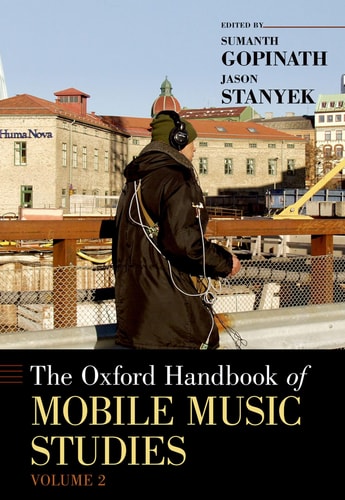
The Oxford Handbook of Mobile Music Studies, Volume 2
0
0
As an Amazon Associate and affiliate partner, Menrva Books earns from qualifying purchases. Learn more
Author Description
The two volumes of The Oxford Handbook of Mobile Music Studies consolidate an area of scholarly inquiry that addresses how mechanical, electrical, and digital technologies and their corresponding economies of scale have rendered music and sound increasingly mobile-portable, fungible, and ubiquitous. At once a marketing term, a common mode of everyday-life performance, and an instigator of experimental aesthetics, "mobile music" opens up a space for studying the momentous transformations in the production, distribution, consumption, and experience of music and sound that took place between the late nineteenth and the early twenty-first centuries. Taken together, the two volumes cover a large swath of the world-the US, the UK, Japan, Brazil, Germany, Turkey, Mexico, France, China, Jamaica, Iraq, the Philippines, India, Sweden-and a similarly broad array of the musical and nonmusical sounds suffusing the soundscapes of mobility.Volume 2 investigates the ramifications of mobile music technologies on musical/sonic performance and aesthetics. Two core arguments are that "mobility" is not the same thing as actual "movement" and that artistic production cannot be absolutely sundered from the performances of quotidian life. The volume's chapters investigate the mobilization of frequency range by sirens and miniature speakers; sound vehicles such as boom cars, ice cream trucks, and trains; the gestural choreographies of soundwalk pieces and mundane interactions with digital media; dance music practices in laptop and iPod DJing; the imagery of iPod commercials; production practices in Turkish political music and black popular music; the aesthetics of handheld video games and chiptune music; and the mobile device as a new musical instrument and resource for musical ensembles.
Menrva's Summary
THE THESIS
This volume investigates how mobile music technologies fundamentally alter the aesthetics and performance of sound in both artistic and quotidian contexts. Edited by Sumanth Gopinath and Jason Stanyek, the work draws upon diverse academic perspectives to argue that mobility is a distinct conceptual category separate from physical movement, and that artistic production is inextricably linked to the performance of daily life.
THE SCOPE MAP
What You Will Find
- Analysis of sound vehicles including boom cars, ice cream trucks, and trains.
- Examination of digital media interactions, including laptop and iPod DJing.
- Studies on the aesthetics of handheld video games and chiptune music.
- Research on the mobilization of frequency ranges in sirens and miniature speakers.
Scope Limits
- The text does not provide a comprehensive history of all portable audio hardware.
- It does not focus on the technical engineering specifications of mobile devices.
THE AUTHORITY PERSPECTIVE
Scholars and musicologists recognize this volume as a significant contribution to the study of soundscapes and digital culture. Readers frequently note the academic density of the prose, which is intended for researchers and students within the fields of ethnomusicology and media studies.
Page Count:
544
Publication Date:
2017-07-27
Publisher:
Oxford University Press
ISBN-10:
019067637X
ISBN-13:
9780190676377
Academic
Musicology
Media Studies
Criticism history
Technology
Sociology
Community Tags
Similar Books