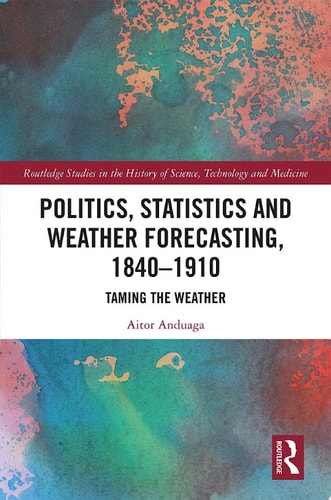
Politics, Statistics and Weather Forecasting, 1840-1910
0
0
As an Amazon Associate and affiliate partner, Menrva Books earns from qualifying purchases. Learn more
Author Description
Weather forecasting is the most visible branch of meteorology and has its modern roots in the nineteenth century when scientists redefined meteorology in the way weather forecasts were made, developing maps of isobars, or lines of equal atmospheric pressure, as the main forecasting tool. This book is the history of how weather forecasting was moulded and modelled by the processes of nation-state building and statistics in the Western world.
Menrva's Summary
THE THESIS
This book investigates the historical development of weather forecasting, tracing its evolution from the mid-nineteenth to the early twentieth century. It examines how the practice of meteorology, particularly the creation of weather forecasts, was fundamentally reshaped by the rise of nation-states and the increasing reliance on statistical methods in the Western world. The narrative focuses on the development and adoption of tools like isobars as central to forecasting, illustrating the intricate relationship between scientific advancement and political structures during this transformative period.
THE SCOPE MAP
- The historical development of weather forecasting as a scientific discipline.
- The role of statistics in shaping meteorological practices and forecast models.
- The influence of nation-state building processes on the organization of weather services.
- The introduction and impact of isobars as a primary forecasting tool.
- The period covered: 1840-1910, focusing on the Western world.
THE AUTHORITY PERSPECTIVE
The book positions itself as a historical account of weather forecasting's transformation, emphasizing the interplay between scientific innovation and political-economic forces. Its focus on the development of statistical methods and tools like isobars suggests a detailed exploration of the technical and institutional changes within meteorology. The framing indicates an analysis of how broader societal and governmental trends influenced the scientific pursuit of understanding and predicting weather patterns.
Page Count:
430
Publication Date:
2019-07-12
Publisher:
Taylor & Francis
ISBN-10:
1000145069
ISBN-13:
9781000145069
History
Science & Technology
Science
Politics
Non-Fiction
Statistics
Community Tags
Similar Books