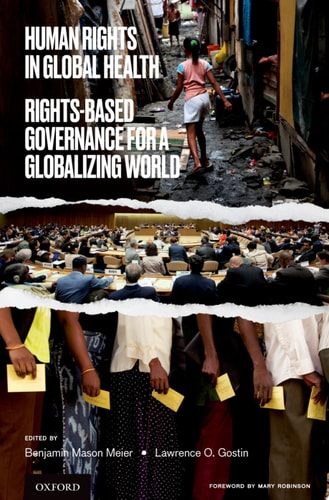
Human Rights in Global Health: Rights-Based Governance for a Globalizing World
0
0
As an Amazon Associate and affiliate partner, Menrva Books earns from qualifying purchases. Learn more
Author Description
Institutions matter for the advancement of human rights in global health. Given the dramatic development of human rights under international law and the parallel proliferation of global institutions for public health, there arises an imperative to understand the implementation of human rights through global health governance. This volume examines the evolving relationship between human rights, global governance, and public health, studying an expansive set of health challenges through a multi-sectoral array of global organizations. To analyze the structural determinants of rights-based governance, the organizations in this volume include those international bureaucracies that implement human rights in ways that influence public health in a globalizing world. This volume brings together leading health and human rights scholars and practitioners from academia, non-governmental organizations, and the United Nations system. They explore the foundations of human rights as a normative framework for global health governance, the mandate of the World Health Organization to pursue a human rights-based approach to health, the role of inter-governmental organizations across a range of health-related human rights, the influence of rights-based economic governance on public health, and the focus on global health among institutions of human rights governance. Contributing chapters each map the distinct human rights efforts within a specific institution of global governance for health. Through the comparative institutional analysis in this volume, the contributing authors examine institutional dynamics to operationalize human rights in organizational policies, programs, and practices and assess institutional factors that facilitate or inhibit human rights mainstreaming for global health advancement.
Menrva's Summary
THE THESIS
This volume investigates how international institutions can effectively implement human rights frameworks to improve global health governance. Benjamin Mason Meier and Lawrence O. Gostin, both prominent scholars in health policy and law, curate a collection of essays that examine the structural determinants of rights-based governance. The authors argue that as global health challenges become increasingly complex, international bureaucracies must integrate human rights norms into their operational policies and practices to ensure equitable health outcomes.
THE SCOPE MAP
What You Will Find
- Analysis of the World Health Organization's mandate regarding human rights.
- Examination of inter-governmental organizations and their influence on health-related rights.
- Evaluation of rights-based economic governance and its impact on public health.
- Comparative institutional analysis of various global governance bodies.
Scope Limits
- The text does not provide a comprehensive history of all human rights treaties.
- It does not offer specific clinical medical advice or individual patient care protocols.
THE AUTHORITY PERSPECTIVE
Experts in international law and global health policy identify this work as a foundational text for understanding the intersection of institutional bureaucracy and human rights. Readers frequently note the academic density of the prose, which is tailored for practitioners, policymakers, and graduate-level students in the field of global health.
Page Count:
611
Publication Date:
2018-01-01
Publisher:
Oxford University Press
ISBN-10:
0190672706
ISBN-13:
9780190672706
Public Health
Right To Health
Medical
Professional Career & Trade
Globalization
Human rights
World Health
Sociology of Health
Allied Health
International Law
Medical Law
Sociology
Health Care
Community Tags
Similar Books