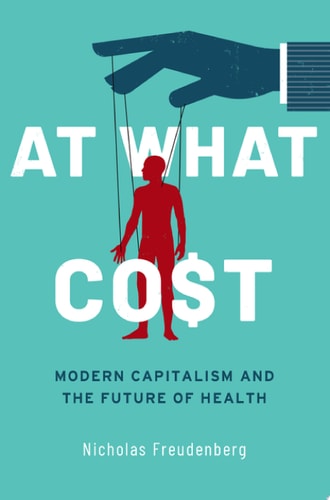
At What Cost: Modern Capitalism and the Future of Health
0
0
As an Amazon Associate and affiliate partner, Menrva Books earns from qualifying purchases. Learn more
Author Description
An incisive and powerful investigation of corporate impact on human and planetary well-beingFreedom of choice lies at the heart of American society. Every day, individuals decide what to eat, which doctors to see, who to connect with online, and where to educate their children. Yet, many Americans don't realize that these choices are illusory at best. By the start of the 21st century, every major industrial sector in the global economy was controlled by no more than five transnational corporations, and in about a third of these sectors, a single company accounted for more than 40 percent of global sales. The available options in food, healthcare, education, transportation, and even online presence are largely constructed by corporations, whose sweeping influence have made them the public face and executive agents of 21st-century capitalism.At What Cost confronts how globalization, financial speculation, monopolies, and control of science and technology have enhanced the ability of corporations and their allies to overwhelm influences of government, family, community, and faith. As corporations manipulate demand through skillful marketing and veto the choices that undermine their bottom line, free consumer choice has all but disappeared, and with it, the personal protections guarding our collective health. At What Cost argues that the world created by 21st-century capitalism is simply not fit to solve our most serious public health problems, from climate change to opioid addiction. However, author and public health expert Nicholas Freudenberg also shows that though the road is steep, human and planetary well-being constitute a powerful mobilizing idea for a new social movement, one that will restore the power of individual voice to our democracy. With impeccably detailed research and an eye towards a better future, At What Cost arms ordinary citizens, activists, and health professionals with an understanding of how we've arrived at the precipice, and what we can do to ensure a healthier collective future.
Menrva's Summary
THE THESIS
This book investigates how the consolidation of corporate power in the 21st century undermines individual autonomy and compromises public health outcomes. Nicholas Freudenberg, a professor of public health, utilizes extensive economic data and historical analysis to argue that the dominance of transnational corporations has eroded the influence of government and community institutions. He posits that the current capitalist framework is fundamentally incompatible with addressing systemic crises such as climate change and the opioid epidemic.
THE SCOPE MAP
What You Will Find
- Analysis of market concentration across sectors including food, healthcare, and technology.
- Examination of how corporate marketing strategies influence consumer behavior and public policy.
- A framework for a social movement centered on human and planetary well-being.
Scope Limits
- The text does not provide a comprehensive history of all economic systems, focusing primarily on 21st-century globalized capitalism.
- It does not offer a detailed legislative roadmap for specific policy changes, focusing instead on broader social mobilization.
THE AUTHORITY PERSPECTIVE
Experts in public health and sociology recognize this work as a rigorous critique of the intersection between corporate interests and social welfare. Readers frequently note the academic density of the prose, which provides a thorough, evidence-based foundation for the author's arguments.
Page Count:
416
Publication Date:
2021-01-01
Publisher:
Oxford University Press
ISBN-10:
0190078642
ISBN-13:
9780190078645
Economics
Public Health
Capitalism
Medical
21st Century
Allied Health
Corporate Responsibility
Health Care
New Used & Rental Textbooks
Sociology
Globalization
Health Policy
Industry
Community Tags
Similar Books