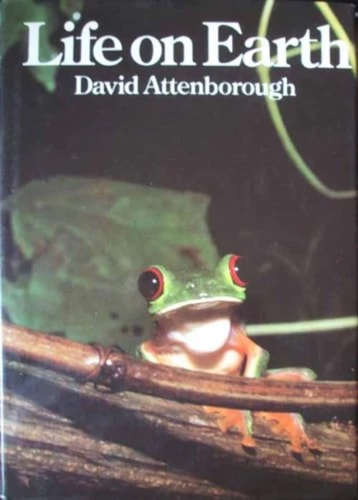
Life on Earth: A Natural History
0
0
As an Amazon Associate and affiliate partner, Menrva Books earns from qualifying purchases. Learn more
Author Description
In this unique book, David Attenborough has undertaken nothing less than a history of nature, from the emergence of tiny one-celled organisms in the primeval slime more than 3,000 million years ago to apelike but upright man, equally well adapted to life in the rain forest of New Guinea and the glass canyons of a modern metropolis. Told through an examination of animal and plant life today - with occasional juxtapositions of extinct fossil forms to reveal the origin of living creatures - "Life on Earth" is an astonishing pageant of life, with a cast of characters drawn from the whole range of living animals the world over. Attenborough's perceptive, dynamic approach to the evolution of some four million species of living organisms that populate the planet is to trace the most significant thread in the history of each major group. He then proceeds to explain from the evidence of living representatives and fossil remains why certain animals adapted and survived, evolved to more complex and "higher" forms of life, while others, by some inherent limitation imposed by their physiology or structure, failed and became extinct. "Life on Earth" is a book of wonders. A model of clarity and ease as a guide, Attenborough takes the reader around the world with him into jungles where orchids have petals that "impersonate" wasps to attract pollinating insects; to Australia, where honeypot ants force feed nectar to workers of a special caste, then hang them up by their forelegs like living storage jars; to remote mountains in Japan where little monkeys called macaques have learned to combat the winter snows by bathing in hot volcanic springs.
Menrva's Summary
THE THESIS
This work investigates the complex trajectory of biological evolution, seeking to explain how life transitioned from primordial single-celled organisms to the diverse array of species inhabiting the modern world. David Attenborough, a renowned naturalist and broadcaster, synthesizes fossil evidence with observations of extant species to construct a comprehensive narrative of adaptation and survival. The book argues that the history of life is defined by the interplay between physiological innovation and environmental pressure, illustrating why certain lineages flourished while others succumbed to extinction.
THE SCOPE MAP
What You Will Find
- A chronological survey of evolutionary milestones spanning over 3,000 million years of history.
- Comparative analysis between extinct fossil forms and their modern biological descendants.
- Detailed case studies of specialized adaptations, such as insect mimicry and primate behavioral responses to climate.
- An examination of the fundamental mechanisms that drive species survival and diversification across global ecosystems.
THE AUTHORITY PERSPECTIVE
This text is widely regarded as a definitive, accessible introduction to natural history, praised for its clarity and the author's ability to synthesize vast scientific concepts into a coherent narrative. The work remains a standard reference for readers seeking a broad, authoritative overview of evolutionary biology and the history of life on Earth.
Page Count:
319
Publication Date:
1979-01-01
Publisher:
Collins
ISBN-10:
0002190915
ISBN-13:
9780002190916
Science
Nature
Natural History
Biology
Organic
Science & Math
Zoology
Evolution
Community Tags
Other Editions(4)

Similar Books

Reader Comments
Share Your Thoughts
No comments yet. Be the first to share your thoughts!