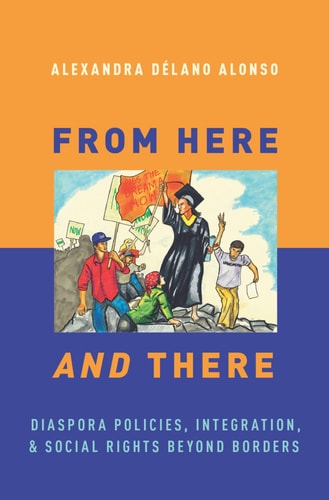
From Here & There: Diaspora Policies, Integration, and Social Rights Beyond Borders
0
0
As an Amazon Associate and affiliate partner, Menrva Books earns from qualifying purchases. Learn more
Author Description
When immigrants to the United States need to learn English, receive health services, open a bank account or get a work certification, US state and local governments or non-profit organizations usually assist as part of the process of supporting immigrant integration and, ultimately, citizenship. But over the past two decades, Mexico, and other origin countries of migrants have been increasingly filling gaps in these activities through their consular representations, particularly focusing on populations with precarious legal status. Put in the larger context of diaspora policies, these practices -- focused on establishing closer ties between the origin country and the emigrant population and protecting their rights through the provision of social services -- are one of the clearest manifestations of the reconceptualization of the boundaries of citizenship and the rights and obligations that come with it.This book looks at citizenship and immigrant integration from the perspective of countries of origin: specifically the processes through which Mexico and other Latin American countries are establishing programs to give their emigrant populations better access to education, health, banking, labor rights, language acquisition and civic participation in the United States. While immigrant integration is often assumed as an issue that mainly concerns the population and institutions of the country of destination, these cases demonstrate the role that origin countries play in supporting migrants' access to opportunities to participate as members of the societies they are a part of, challenging the limits of citizenship and sovereignty, and offering examples of innovative practices in the protection of migrants' rights. As an area of migration governance that is rarely discussed, this book offers a critical evaluation of these programs and their impact on emigrants, particularly on those who are undocumented or have precarious legal status, and the collaborations between gove
Menrva's Summary
THE THESIS
This book investigates how countries of origin, particularly Mexico and other Latin American nations, are redefining the boundaries of citizenship by providing social services and support to their emigrant populations in the United States. Alexandra Délano Alonso, an expert in migration and diaspora policies, utilizes a framework of transnational governance to analyze how these origin states fill gaps in integration services for migrants, especially those with precarious legal status. The work argues that these state-led initiatives challenge traditional notions of sovereignty and the conventional understanding of immigrant integration as solely the responsibility of the destination country.
THE SCOPE MAP
What You Will Find
- Analysis of consular programs providing education, health, and financial services to migrants.
- Examination of the shifting relationship between origin states and their diaspora populations.
- Case studies focusing on Mexico and various Latin American countries.
- Discussion of the legal and political implications for undocumented or precarious status migrants.
Scope Limits
- The text focuses primarily on the United States as the destination country and does not provide an exhaustive global survey of all diaspora policies.
- The analysis does not cover the long-term historical evolution of citizenship laws prior to the last two decades.
THE AUTHORITY PERSPECTIVE
Scholars in migration studies identify this work as a significant contribution to the understanding of transnational state-diaspora relations. Readers frequently note the academic rigor and the clarity with which the author navigates complex questions regarding sovereignty and social rights.
Page Count:
256
Publication Date:
2018-05-10
Publisher:
Oxford University Press
ISBN-10:
0190688580
ISBN-13:
9780190688585
Sociology
Migration Studies
United States
International relations
Citizenship
American Studies
Community Tags
Similar Books