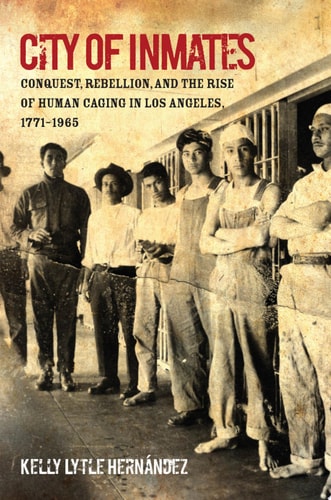
City of Inmates: Conquest, Rebellion, and the Rise of Human Caging in Los Angeles, 1771–1965
0
0
As an Amazon Associate and affiliate partner, Menrva Books earns from qualifying purchases. Learn more
Author Description
Los Angeles incarcerates more people than any other city in the United States, which imprisons more people than any other nation on Earth. This book explains how the City of Angels became the capital city of the world’s leading incarcerator. Marshaling more than two centuries of evidence, historian Kelly Lytle Hernández unmasks how histories of native elimination, immigrant exclusion, and black disappearance drove the rise of incarceration in Los Angeles. In this telling, which spans from the Spanish colonial era to the outbreak of the 1965 Watts Rebellion, Hernández documents the persistent historical bond between the racial fantasies of conquest, namely its settler colonial form, and the eliminatory capacities of incarceration. But City of Inmates is also a chronicle of resilience and rebellion, documenting how targeted peoples and communities have always fought back. They busted out of jail, forced Supreme Court rulings, advanced revolution across bars and borders, and, as in the summer of 1965, set fire to the belly of the city. With these acts those who fought the rise of incarceration in Los Angeles altered the course of history in the city, the borderlands, and beyond. This book recounts how the dynamics of conquest met deep reservoirs of rebellion as Los Angeles became the City of Inmates, the nation’s carceral core. It is a story that is far from over.
Menrva's Summary
THE THESIS
This book investigates how Los Angeles became the global capital of incarceration, exploring the historical roots of its carceral system. Historian Kelly Lytle Hernández marshals over two centuries of evidence to demonstrate how the city's rise as a carceral center is intertwined with histories of native elimination, immigrant exclusion, and Black disappearance. The narrative spans from the Spanish colonial era to the 1965 Watts Rebellion, revealing the persistent link between racial conquest and the expansion of incarceration. However, the book also chronicles the resilience and resistance of those targeted by this system, highlighting their efforts to dismantle it through various acts of rebellion.
THE SCOPE MAP
- The historical development of incarceration in Los Angeles from 1771 to 1965.
- Analysis of the roles of native elimination, immigrant exclusion, and Black disappearance in shaping the carceral landscape.
- The connection between settler colonial conquest and the rise of mass incarceration.
- Documentation of resistance and rebellion against the carceral system by targeted communities.
- Case studies of jail breaks, legal challenges, and social unrest, including the 1965 Watts Rebellion.
- The book's argument that Los Angeles serves as the nation's carceral core.
THE AUTHORITY PERSPECTIVE
This book is recognized for its rigorous historical analysis, tracing the deep roots of mass incarceration in Los Angeles. It is lauded for connecting the city's carceral present to its colonial past and racialized social structures. The work is also noted for its focus on the agency and resistance of those subjected to the carceral system, offering a nuanced perspective on historical struggles for freedom and justice.
Page Count:
312
Publication Date:
2017-02-15
Publisher:
The University of North Carolina Press
ISBN-10:
1469631199
ISBN-13:
9781469631196
History
Non-Fiction
Social History
American Studies
Criminology
Urban Studies
Community Tags
Similar Books