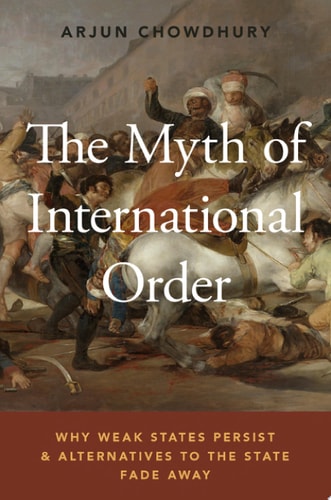
The Myth of International Order: Why Weak States Persist and Alternatives to the State Fade Away
0
0
As an Amazon Associate and affiliate partner, Menrva Books earns from qualifying purchases. Learn more
Author Description
In February of 2011, Libyan citizens rebelled against Muammar Qaddafi and quickly unseated him. The speed of the regime's collapse confounded many observers, and the ensuing civil war showed Foreign Policy's index of failed states to be deeply flawed--FP had, in 2010, identified 110 states as being more likely than Libya to descend into chaos. They were spectacularly wrong, but this points to a larger error in conventional foreign policy wisdom: failed, or weak and unstable, states are not anomalies but are instead in the majority. More states resemble Libya than Sweden.Why are most states weak and unstable? Taking as his launching point Charles Tilly's famous dictum that 'war made the state, and the state made war,' Arjun Chowdhury argues that the problem lies in our mistaken equation of democracy and economic power with stability. But major wars are the true source of stability: only the existential crisis that such wars produced could lead citizens to willingly sacrifice the resources that allowed the state to build the capacity it needed for survival. Developing states in the postcolonial era never experienced the demands major interstate war placed on European states, and hence citizens in those nations have been unwilling to sacrifice the resources that would build state capacity. For example, India and Mexico are established democracies with large economies. Despite their indices of stability, both countries are far from stable: there is an active Maoist insurgency in almost a quarter of India's districts, and Mexico is plagued by violence, drug trafficking, and high levels of corruption in local government. Nor are either effective at collecting revenue. As a consequence, they do not have the tax base necessary to perform the most fundamental tasks of modern states: controlling organized violence in a given territory and providing basic services to citizens. By this standard, the majority of states in the world--about two thirds--are weak states.
Menrva's Summary
THE THESIS
Why do the majority of modern states remain weak and unstable despite global expectations of institutional development? Arjun Chowdhury, a scholar of international relations, challenges the conventional wisdom that equates economic growth and democratic governance with state stability. He argues that the historical development of strong states was predicated on the existential pressures of major interstate warfare, a catalyst absent in the postcolonial era, which prevents modern states from securing the necessary citizen cooperation to build robust institutional capacity.
THE SCOPE MAP
What You Will Find
- A critique of the 'failed state' index methodology used by organizations like Foreign Policy.
- An application of Charles Tilly's historical framework regarding war and state formation to the modern postcolonial context.
- Comparative analysis of state capacity in nations like India and Mexico.
Scope Limits
- The text does not provide a comprehensive policy manual for immediate state stabilization.
- It does not focus on non-state actors outside of their relationship to the central state apparatus.
THE AUTHORITY PERSPECTIVE
Scholars in political science frequently cite this work for its provocative re-evaluation of state-building theories and its departure from liberal institutionalist orthodoxy. Readers often note the academic density of the prose, which requires a foundational understanding of international relations theory to fully appreciate the author's arguments.
Page Count:
270
Publication Date:
2017-01-01
Publisher:
Oxford University Press
ISBN-10:
019068674X
ISBN-13:
9780190686741
History
International relations
Geopolitics
Public Policy
State Building
Community Tags
Other Editions(3)
Similar Books


Reader Comments
Share Your Thoughts
No comments yet. Be the first to share your thoughts!