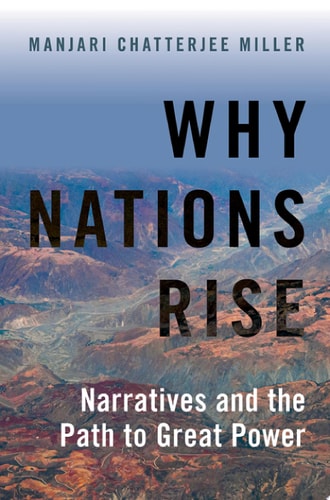
Why Nations Rise: Narratives and the Path to Great Power
0
0
As an Amazon Associate and affiliate partner, Menrva Books earns from qualifying purchases. Learn more
Author Description
What are rising powers? Do they challenge the international order? Why do some countries but not others become rising powers? In Why Nations Rise, Manjari Chaterjee Miller answers these questions and shows that some countries rise not just because they develop the military and economic power to do so but because they develop particular narratives about how to become a great power in the style of the great power du jour. These active rising powers accept the prevalent norms of the international order in order to become great powers. On the other hand, countries which have military and economic power but not these narratives do not rise enough to become great powers--they stay reticent powers. An examination of the narratives in historical (the United States, the Netherlands, Meiji Japan) and contemporary (Cold War Japan, post-Cold War China and India) cases, Why Nations Rise shows patterns of active and reticent rising powers and presents lessons for how to understand the rising powers of China and India today.
Menrva's Summary
THE THESIS
This book investigates why certain nations successfully ascend to great power status while others with comparable economic and military resources remain reticent. Manjari Chatterjee Miller, an expert in international relations, argues that the transition to great power status is contingent upon the development of specific national narratives that align with the prevailing international order. By analyzing how states adopt or reject existing global norms, the author provides a framework for distinguishing between active rising powers and those that fail to leverage their potential.
THE SCOPE MAP
What You Will Find
- Comparative analysis of historical powers including the United States, the Netherlands, and Meiji Japan.
- Examination of contemporary cases such as Cold War Japan, China, and India.
- A theoretical framework distinguishing between active and reticent rising powers.
Scope Limits
- The analysis focuses primarily on narrative construction and norm adoption rather than purely quantitative economic forecasting.
- It does not provide an exhaustive history of every global power, but rather selects specific case studies to illustrate the narrative theory.
THE AUTHORITY PERSPECTIVE
Experts in international relations recognize this work as a significant contribution to the study of power transitions and state behavior. Readers frequently note the clarity of the author's narrative-based framework when applied to the complex geopolitical trajectories of modern China and India.
Page Count:
208
Publication Date:
2021-01-01
Publisher:
Oxford University Press
ISBN-10:
0190639954
ISBN-13:
9780190639952
History
Geopolitics
Great powers
International relations
Global Studies
Public Policy
Community Tags
Similar Books