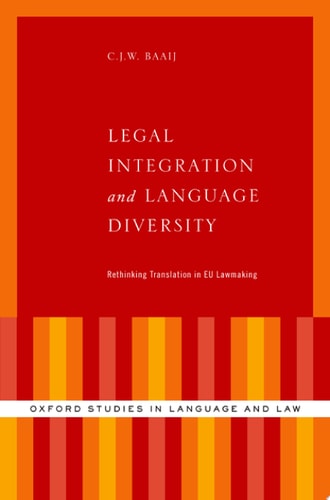
Legal Integration and Language Diversity: Rethinking Translation in EU Lawmaking
0
0
As an Amazon Associate and affiliate partner, Menrva Books earns from qualifying purchases. Learn more
Author Description
How can the European Union create laws that are uniform in a multitude of languages? Specifically, how can it attain both legal integration and language diversity simultaneously, without the latter compromising the former? C.J.W. Baaij argues that the answer lies in the domain of translation. A uniform interpretation and application of EU law begins with the ways in which translators and jurist-linguists of the EU legislative bodies translate the original legislative draft texts into the various language versions. In the European Union, law and language are inherently connected. The EU pursues legal integration, i.e. the incremental harmonization and unification of its Member States' laws, for the purpose of reducing national regulatory differences between Member States. However, in its commitment to the diversity of European languages, its legislative institutions enact legislative instruments in 24 languages. Language Diversity and Legal Integration assesses these seemingly incompatible policy objectives and contemporary translation practices in the EU legislative procedure, and proposes an alternative, source-oriented approach that better serves EU policy objectives. Contrary to the orthodox view in academic literature and to the current policies of the EU, this book suggests that the English language version should serve as the original and only authentic legislative text. Translation into the other language versions should furthermore avoid prioritizing clarity and fluency over syntactic correspondence and employ neologisms for distinctly EU legal concepts.Ultimately, Baaij provides practical solutions to the conflict between the equality of all language versions, and the need for uniform interpretation and application of EU law.
Menrva's Summary
THE THESIS
How can the European Union reconcile the requirement for uniform legal application with its commitment to legislative multilingualism? C.J.W. Baaij, a scholar specializing in the intersection of law and language, examines the current practices of EU legislative bodies to identify systemic inefficiencies in translation. The author argues that the prevailing policy of treating all 24 official language versions as equally authentic undermines legal integration and proposes a shift toward a source-oriented translation model centered on the English text.
THE SCOPE MAP
What You Will Find
- Analysis of EU legislative drafting and translation procedures
- Evaluation of the conflict between legal harmonization and linguistic diversity
- Proposed methodology for syntactic correspondence in legal translation
- Recommendations for the use of neologisms in EU legal terminology
Scope Limits
- Does not provide a comprehensive history of all EU treaties
- Does not focus on judicial interpretation by the Court of Justice of the European Union beyond its relation to legislative drafting
THE AUTHORITY PERSPECTIVE
Legal scholars and practitioners recognize this work as a rigorous examination of the technical challenges inherent in EU lawmaking. Experts frequently cite the text for its provocative proposal regarding the status of the English language version in the legislative process.
Page Count:
310
Publication Date:
2018-01-01
Publisher:
Oxford University Press
ISBN-10:
0190680806
ISBN-13:
9780190680800
Translation Studies
Law
European Union
Professional Career & Trade
Linguistics
Legal Theory
Community Tags
Similar Books