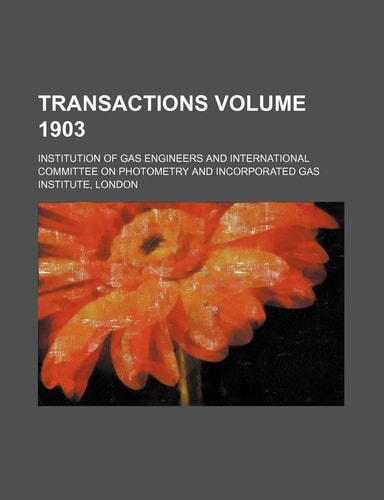
Transactions Volume 1903
0
0
As an Amazon Associate and affiliate partner, Menrva Books earns from qualifying purchases. Learn more
Author Description
This historic book may have numerous typos and missing text. Purchasers can download a free scanned copy of the original book (without typos) from the publisher. Not indexed. Not illustrated. 1904 Excerpt:...of the calorific value a most laborious operation, but would also leave loopholes for so many sources of error that the results would be open to grave doubt. Given a good analysis, however, calculation enables one not only to obtain the calorific value under conditions where direct determination would be impossible, but also affords us an insight into the cause of any abnormal variation in thermal. value which might otherwise be diff1cult.to trace. Taking the calculation of the calorif1c value just given, it is clear that more than two-thirds of its heating power are due to the hydrocarbons present in it, and that methane is the factor which makes a good coal gas so superior to all other forms of gaseous fuel. The possibility of directly determining the calorific value of a combustible gas has only been placed within the reach of the gas manager during the past ten years by the introduction of that beautiful instrument that we all know as the Junkers calorimeter, and which has been so often brought before you as to need no fresh description from me. In this instrument, the heat generated by a flame is transmitted to water; measurement of the gas burned, and the volume and rise of temperature in the water giving all the data necessary to calculate the calorific value of the gas. The ease, rapid1ty, and accuracy with which determinations of thermal value in gases could be made by this apparatus have in reality created the possibility of a practical standard of heat value; and, as was to be expected, a rival calorimeter has appeared on the market in a modification of the Junkers apparatus, known as the Simmance-Abady calorimeter. I have frequently been asked as to the relative accuracy of the two forms of apparatus; and in order to provide an answer to the que...
Menrva's Summary
THE THESIS
This volume presents historical research and findings from the Institution of Electrical and Electronics Engineers in 1903. The content focuses on technical discussions and experimental results from that era, likely detailing advancements and challenges in electrical and electronic engineering. The excerpt suggests a deep dive into the calculation and determination of calorific values in gases, highlighting the importance of accurate measurement and the development of new instruments like the Junkers calorimeter.
THE SCOPE MAP
- Technical papers and research from the Institution of Electrical and Electronics Engineers.
- Discussions on the calculation and direct determination of calorific values in combustible gases.
- Analysis of instruments such as the Junkers calorimeter and the Simmance-Abady calorimeter.
- Historical context of electrical and electronic engineering advancements in 1903.
- Potential for typos and missing text in the original scanned copy, with a note about a cleaner digital version.
THE AUTHORITY PERSPECTIVE
This book is a historical record of technical proceedings from 1903. The provided excerpt indicates a focus on scientific measurement and instrumentation, particularly concerning calorific values in gases. The publisher notes that the physical copy may contain errors, offering a scanned version for clarity. The content is likely of interest to historians of science and engineering, or specialists in the field of thermodynamics and gas analysis.
Page Count:
108
Publication Date:
2012-05-20
Publisher:
RareBooksClub.com
ISBN-10:
1236316444
ISBN-13:
9781236316448
Non-Fiction
Science
Science & Technology
History
Engineering
Community Tags
Similar Books