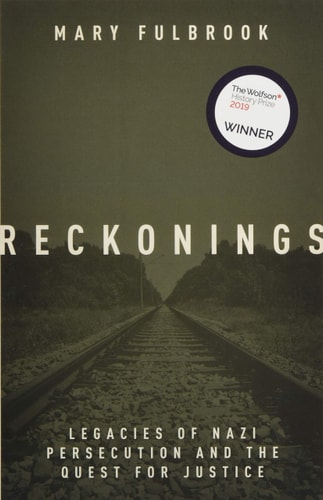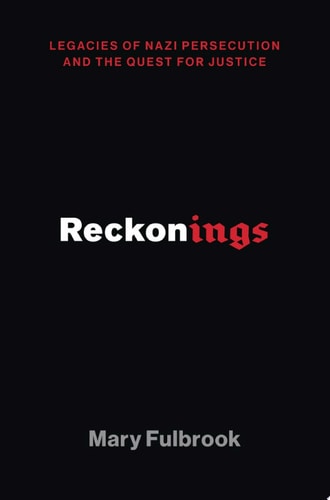
Reckonings: Legacies of Nazi Persecution and the Quest for Justice
0
0
As an Amazon Associate and affiliate partner, Menrva Books earns from qualifying purchases. Learn more
Author Description
Winner of the Wolfson History Prize 2019 Shortlisted for the 2019 Cundill History Prize From the Holocaust Museum in Washington, D.C. to the "stumbling stones" embedded in Berlin sidewalks, memorials to victims of Nazi violence have proliferated across the globe. More than a million visitors — as many as killed there during its operation — now visit Auschwitz each year. There is no shortage of commemoration of Nazi crimes. But has there been justice? Reckonings shows persuasively that there has not. The name "Auschwitz," for example, is often evoked to encapsulate the Holocaust. Yet focusing on one concentration camp, however horrific the scale of the crimes committed there, does not capture the myriad ways individuals became tangled up on the side of the perpetrators, or the diversity of experiences among their victims. And it can obscure the continuing legacies of Nazi persecution across generations and across continents.Exploring the lives of individuals across a spectrum of suffering and guilt — each one capturing one small part of the greater story — Mary Fulbrook's haunting and powerful book uses "reckoning" in the widest possible sense: to reveal the disparity between the extent of inhumanity and later attempts to interpret and rectify wrongs, as the consequences of violent reverberated through time. From the early brutality of political oppression and anti-Semitic policies, through the "euthanasia" program, to the full devastation of the ghettos and death camps, then moving across the post-war decades of selective confrontation with perpetrators and ever-expanding recognition of victims, Reckonings exposes the disjuncture between official myths about "dealing with the past" and the fact that the vast majority of Nazi perpetrators were never held accountable. In the successor states to the Third Reich — East Germany, West Germany, and Austria — prosecution varied widely and selective justice was combined with the reintegration of former Nazis.
Menrva's Summary
THE THESIS
This work investigates the profound disparity between the scale of Nazi-era atrocities and the subsequent, often inadequate, legal and social attempts to achieve justice for victims. Mary Fulbrook, a distinguished historian of modern Germany, utilizes extensive archival research and individual case studies to challenge the official narratives of post-war reconciliation. She argues that the selective prosecution of perpetrators and the integration of former Nazis into successor states created a persistent failure to address the full scope of historical guilt and trauma.
THE SCOPE MAP
What You Will Find
- Comparative analysis of legal proceedings in East Germany, West Germany, and Austria.
- Examination of diverse victim experiences ranging from political prisoners to those targeted by the euthanasia program.
- Analysis of the evolution of public memory and commemoration from the post-war era to the present.
Scope Limits
- The book does not provide a comprehensive legal encyclopedia of every individual trial conducted after 1945.
- It focuses primarily on the German-speaking successor states rather than the global geopolitical implications of the Nuremberg trials.
THE AUTHORITY PERSPECTIVE
Historians and scholars of the Holocaust recognize this work as a significant contribution to the study of post-war justice and the complexities of historical memory. Readers frequently note the academic density of the prose and the author's meticulous attention to the lived experiences of both victims and perpetrators.
Page Count:
669
Publication Date:
2018-01-01
Publisher:
Oxford University Press
ISBN-10:
0190681268
ISBN-13:
9780190681265
History
Justice
War Crime Trials
European History
Twentieth Century
Jewish History
Influence Literary artistic etc
Community Tags
Similar Books