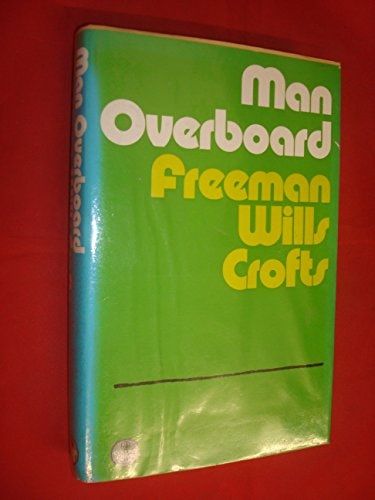
Man Overboard
0
0
As an Amazon Associate and affiliate partner, Menrva Books earns from qualifying purchases. Learn more
Author Description
Product Description In the course of a ship’s passage from Belfast to Liverpool a man disappears. His body is picked up by Irish fishermen. Although the coroner’s verdict is suicide, murder is suspected. Inspector French co-operates with Superintendent Rainey and Sergeant McClung once more to determine the truth. About the Author Freeman Wills Crofts was born in Dublin in 1879 and died in 1957. He worked for a Northern Irish railway company as an engineer until 1929, before turning to detective fiction His plots reveal his mathematical training and he specialised in the seemingly unbreakable alibi, laying layer upon layer within his stories. He loved ships and trains and the intricacies of transport timetables feature in many of his stories. Crofts’ best-known character is Inspector Joseph French. French appears for the first time in Inspector French’s Greatest Case. He is a detective who achieves his results through dogged persistence.
Menrva's Summary
THE PULSE
When a passenger vanishes during a routine voyage from Belfast to Liverpool, Inspector Joseph French must determine if the death is a tragic suicide or a calculated murder. Tasked with investigating the suspicious recovery of a body by local fishermen, French navigates the bureaucratic and logistical challenges of a cross-jurisdictional case. He works alongside Superintendent Rainey and Sergeant McClung, employing his trademark methodical approach to dismantle the coroner's initial findings. The narrative follows a traditional third-person perspective, focusing on the meticulous gathering of evidence and the systematic elimination of false leads.
INSIDE THE PAGES
- Focus on the technicalities of transportation and maritime schedules
- Emphasis on the 'unbreakable alibi' as a central plot device
- Procedural investigation involving multiple law enforcement agencies
- Systematic, step-by-step deduction by the protagonist
- Setting shifts between Belfast, Liverpool, and the Irish Sea
- Detailed examination of forensic and circumstantial evidence
- Slow-burn pacing characteristic of Golden Age detective fiction
- Logical deconstruction of a coroner's verdict
THE COLLECTIVE ECHO
This work is characteristic of the Golden Age of detective fiction, reflecting the author's background in engineering through its precise and methodical narrative structure. The story relies on the reader's appreciation for technical detail and the slow, deliberate unraveling of a complex alibi. Inspector French serves as a grounded, persistent investigator whose success stems from diligence rather than intuition. The narrative style prioritizes logical consistency and the mechanics of the crime over high-octane action, appealing to those who enjoy classic puzzle-based mysteries.
Page Count:
320
Publication Date:
1973-01-01
Publisher:
HarperCollins Distribution Services
ISBN-10:
0002315335
ISBN-13:
9780002315333
Mystery
Classic Crime
Mystery Thriller & Suspense
Detective
Community Tags
Similar Books