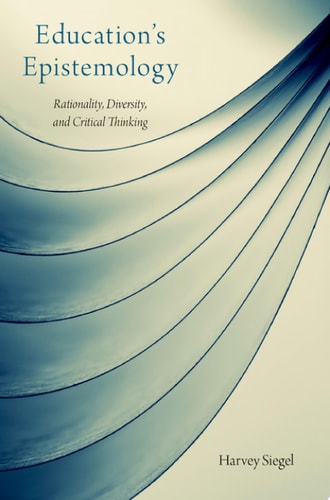
Education's Epistemology: Rationality, Diversity, and Critical Thinking
0
0
As an Amazon Associate and affiliate partner, Menrva Books earns from qualifying purchases. Learn more
Author Description
Education's Epistemology extends and further defends Harvey Siegel's "reasons conception" of critical thinking. It analyzes and emphasizes both the epistemic quality, and the dispositions and character traits that constitute the "critical spirit," that are central to a proper account of critical thinking; argues that that epistemic quality must be understood ultimately in terms of epistemic rationality; defends a conception of rationality that involves both rules and judgment; and argues that critical thinking has normative value over and above its instrumental tie to truth. Siegel also argues, contrary to currently popular multiculturalist thought, for both transcultural and universal philosophical ideals, including those of multiculturalism and critical thinking themselves.
Menrva's Summary
THE THESIS
This work investigates the foundational role of epistemic rationality in defining the concept of critical thinking within educational theory. Harvey Siegel, a prominent philosopher of education, utilizes his established "reasons conception" to argue that critical thinking is not merely a set of skills but a normative commitment to rationality. He posits that this framework necessitates both adherence to logical rules and the exercise of sound judgment, while simultaneously defending universal philosophical ideals against certain strands of multiculturalist critique.
THE SCOPE MAP
What You Will Find
- A defense of the "reasons conception" of critical thinking
- Analysis of the relationship between epistemic quality and rationality
- Philosophical arguments regarding transcultural and universal ideals
- Examination of the character traits and dispositions constituting the "critical spirit"
Scope Limits
- The text does not provide a practical classroom curriculum or pedagogical manual
- It does not focus on empirical psychological studies of student cognition
THE AUTHORITY PERSPECTIVE
Scholars in the philosophy of education recognize this text as a rigorous defense of universalist approaches to critical thinking. Readers frequently note the academic density of the prose, which is intended for an audience familiar with analytic philosophy and educational theory.
Page Count:
312
Publication Date:
2017-01-01
Publisher:
Oxford University Press
ISBN-10:
0190682698
ISBN-13:
9780190682699
Philosophy
Professional Career & Trade
Knowledge Theory
Education
Logic & Critical Reasoning
Educational Theory
Educational Foundations
Epistemology
Critical thinking
Community Tags
Similar Books
![Reason in the Balance: An Inquiry Approach to Critical Thinking [Paperback]](https://storage.googleapis.com/menrva_img_storage/covers/9780070073418.jpg)