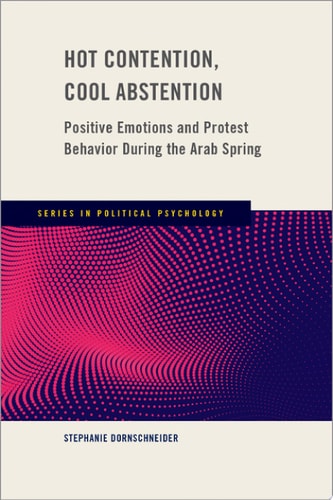
Hot Contention, Cool Abstention: Positive Emotions and Protest Behavior During the Arab Spring
0
0
As an Amazon Associate and affiliate partner, Menrva Books earns from qualifying purchases. Learn more
Author Description
Why did people mobilize for the Arab Spring? While existing research has focused on the roles of authoritarian regimes, oppositional structures, and social grievances in the movement, these explanations fail to address differences in the behavior of individuals, overlooking the fact that even when millions mobilized for the Arab Spring, the majority of the population stayed at home. To investigate this puzzle, this book traces the reasoning processes by which individuals decided to join the uprisings, or to refrain from doing so. Drawing from original ethnographic interviews with protestors and non-protestors in Egypt and Morocco, Dornschneider utilizes qualitative methods and computational modeling to identify the main components of reasoning processes: beliefs, inferences (directed connections between beliefs), and decisions. Bridging the psychology literature on reasoning and the political science literature on protest, this book systematically traces how decisions about participating in the Arab Spring were made. It shows that decisions to join the uprisings were "hot," meaning they were based on positive emotions, while decisions to stay at home were "cool," meaning they were based on safety considerations. Hot Contention, Cool Abstention adds to the extensive literature on political uprisings, offering insights on how and why movements start, stall, and evolve.
Menrva's Summary
THE THESIS
This book investigates the cognitive and emotional reasoning processes that led individuals to either participate in or abstain from the Arab Spring uprisings. Stephanie Dornschneider, a scholar in political psychology, utilizes a framework that bridges psychological reasoning models with political science theories of protest. By analyzing original ethnographic interviews from Egypt and Morocco, the author argues that participation was driven by 'hot' positive emotions, whereas abstention was governed by 'cool' safety-oriented calculations.
THE SCOPE MAP
What You Will Find
- A comparative analysis of protest behavior in Egypt and Morocco.
- A methodological framework integrating qualitative ethnographic interviews with computational modeling.
- A breakdown of reasoning components including beliefs, inferences, and decision-making pathways.
Scope Limits
- The study does not provide a comprehensive historical account of the Arab Spring as a whole.
- It does not focus on macro-level geopolitical factors or state-level authoritarian structures.
THE AUTHORITY PERSPECTIVE
Scholars in political science and psychology note that this work provides a rigorous micro-level analysis of protest behavior that complements existing structural explanations. Experts highlight the book as a significant contribution to the study of individual decision-making within high-stakes political movements.
Page Count:
192
Publication Date:
2020-01-01
Publisher:
Oxford University Press
ISBN-10:
0190693924
ISBN-13:
9780190693923
Political Psychology
Sociology
Middle Eastern
Qualitative Research
Community Tags
Similar Books