The Only Constant Is Change: Technology, Political Communication, and Innovation Over Time
0
0
As an Amazon Associate and affiliate partner, Menrva Books earns from qualifying purchases. Learn more
Author Description
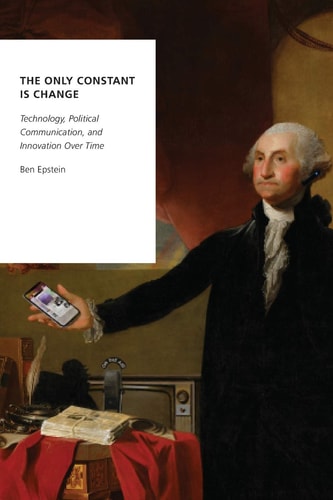
Over the course of American political history, political elites and organizations have often updated their political communications strategies in order to achieve longstanding political communication goals in more efficient or effective ways. But why do successful innovations occur when they do, and what motivates political actors to make choices about how to innovate their communication tactics?Covering over 300 years of political communication innovations, Ben Epstein shows how this process of change happens and why. To do this, Epstein, following an interdisciplinary approach, proposes a new model called "the political communication cycle" that accounts for the technological, behavioral, and political factors that lead to revolutionary political communication changes over time. These changes (at least the successful ones) have been far from gradual, as long periods of relatively stable political communication activities have been disrupted by brief periods of dramatic and permanent transformation. These transformations are driven by political actors and organizations, and tend to follow predictable patterns.Epstein moves beyond the technological determinism that characterizes communication history scholarship and the medium-specific focus of much political communication work. The book identifies the political communication revolutions that have, in the United States, led to four, relatively stable political communication orders over history: the elite, mass, broadcast, and (the current) information orders. It identifies and tests three phases of each revolutionary cycle, ultimately sketching possible paths for the future. The Only Constant is Change offers readers and scholars a model and vocabulary to compare political communication changes across time and between different types of political organizations. This provides greater understanding of where we are currently in the recurring political communication cycle, and where we might be headed.
Menrva's Summary
THE THESIS
This book investigates the drivers of innovation in American political communication and why specific technological or strategic shifts occur at particular historical junctures. Ben Epstein, a scholar of digital politics, utilizes an interdisciplinary framework to move beyond technological determinism. He introduces the "political communication cycle" model, which posits that political communication evolves through punctuated equilibrium—long periods of stability interrupted by rapid, transformative revolutions driven by political actors and organizations.
THE SCOPE MAP
What You Will Find
- A longitudinal analysis of 300 years of American political communication history.
- The "political communication cycle" model consisting of three distinct phases.
- Identification of four historical communication orders: elite, mass, broadcast, and information.
- Comparative analysis of political organizations and their strategic choices.
Scope Limits
- The analysis is primarily focused on the United States political context.
- The work does not provide a comprehensive technical manual for modern digital campaigning tools.
THE AUTHORITY PERSPECTIVE
Scholars and political analysts frequently note that this text provides a useful vocabulary for comparing historical communication shifts against contemporary digital trends. Experts highlight the book as a significant departure from medium-specific studies, offering a broader structural framework for understanding political innovation.
Page Count:
272
Publication Date:
2018-05-01
Publisher:
Oxford University Press
ISBN-10:
0190698977
ISBN-13:
9780190698973
History
Communication Studies
American Politics
Technology
Communication in politics
Mass media
United States
Digital Media
Community Tags
Similar Books