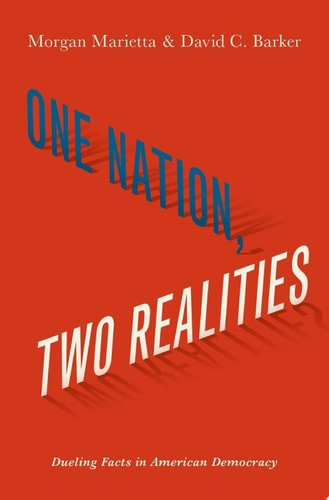
One Nation, Two Realities: Dueling Facts in American Democracy
0
0
As an Amazon Associate and affiliate partner, Menrva Books earns from qualifying purchases. Learn more
Author Description
The deep divides that define politics in the United States are not restricted to policy or even cultural differences anymore. Americans no longer agree on basic questions of fact. Is climate change real? Does racism still determine who gets ahead? Is sexual orientation innate? Do immigration and free trade help or hurt the economy? Does gun control reduce violence? Are false convictions common?Employing several years of original survey data and experiments, Marietta and Barker reach a number of enlightening and provocative conclusions: dueling fact perceptions are not so much a product of hyper-partisanship or media propaganda as they are of simple value differences and deepening distrust of authorities. These duels foster social contempt, even in the workplace, and they warp the electorate. The educated -- on both the right and the left -- carry the biggest guns and are the quickest to draw. And finally, fact-checking and other proposed remedies don't seem to holster too many weapons; they can even add bullets to the chamber. Marietta and Barker's pessimistic conclusions will challenge idealistic reformers.
Menrva's Summary
THE THESIS
This book investigates why Americans increasingly disagree on fundamental questions of fact and how these divergent realities impact the health of the nation's democracy. Authors David C. Barker and Morgan Marietta, both scholars in political science, utilize original survey data and experimental research to argue that these disagreements stem from deep-seated value differences and a pervasive distrust of institutional authorities rather than mere media bias or partisan affiliation. They contend that these 'dueling facts' create social friction and that traditional interventions, such as fact-checking, often fail to bridge the divide.
THE SCOPE MAP
What You Will Find
- Analysis of public opinion regarding climate change, immigration, gun control, and systemic racism.
- Examination of the correlation between educational attainment and the intensity of factual polarization.
- Evaluation of the efficacy of fact-checking and media literacy initiatives.
Scope Limits
- The study focuses primarily on the American political landscape and does not provide a comparative analysis of factual polarization in other democratic nations.
- The text does not offer a comprehensive policy manual for resolving these disputes, focusing instead on the sociological and psychological drivers of the phenomenon.
THE AUTHORITY PERSPECTIVE
Experts and political commentators frequently cite this work as a significant contribution to understanding the psychological underpinnings of modern political polarization. Readers often note that the authors provide a sobering, data-driven assessment that challenges common assumptions about the role of media and education in shaping public discourse.
Page Count:
358
Publication Date:
2019-01-01
Publisher:
Oxford University Press
ISBN-10:
0190677198
ISBN-13:
9780190677190
Public opinion
Public Policy
Communication in politics
Democracy
American Politics
Media Studies
Introduction to Human Communication
Communications
Sociology
Community Tags
Similar Books