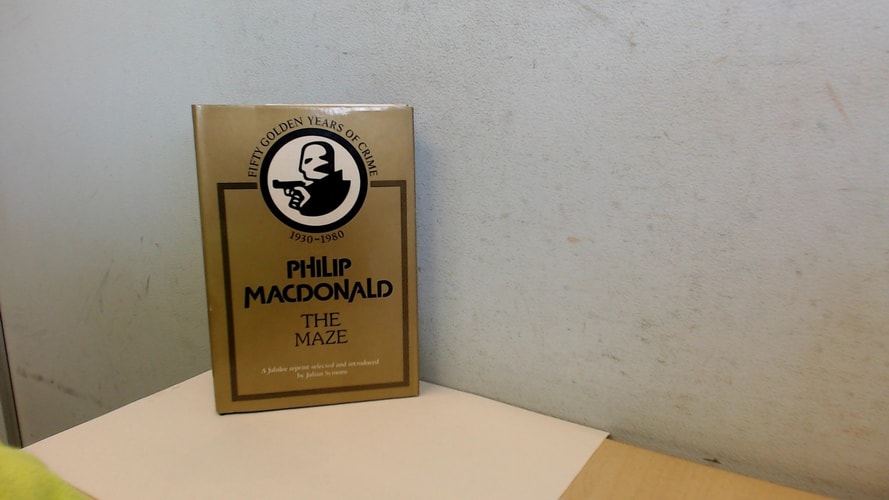
The Maze
0
0
As an Amazon Associate and affiliate partner, Menrva Books earns from qualifying purchases. Learn more
Author Description
The ultimate murder mystery - can you find the murderer before the detective? Maxwell Brunton was found dead in his study – murdered beyond doubt. There were ten people in the house on the night of the murder, and at least seven of them had an adequate motive for murdering him. But Anthony Gethryn has only the evidence given at the Coroner’s inquest to work with. In other words YOU, the reader, and HE, the detective, are upon equal footing. HE solves the mystery. Can YOU? The Maze, first published in 1932, is Philip MacDonald’s contribution to the conception of the totally logical puzzle – an exercise in ratiocination, as Poe called it – which so preoccupied detective story writers in the ‘Golden Age’ of the 1920s and ’30s. Written in the form of a court transcript, it is the ultimate puzzle novel, an absolutely fair test of the reader’s ability as a detective... an enthralling story – one of Philip MacDonald’s best. This Detective Story Club classic includes an introduction by Julian Symons, who selected The Maze for the Crime Club’s 1980 Jubilee reprint series, celebrating the best of 50 golden years of crime publishing.
Menrva's Summary
THE PULSE
When Maxwell Brunton is discovered dead in his study, detective Anthony Gethryn must navigate a house filled with ten suspects, seven of whom possess clear motives for the crime. Gethryn operates under the strict constraint of relying solely on the evidence presented during the Coroner’s inquest, placing him on equal footing with the reader. The narrative unfolds through the unconventional framework of a court transcript, challenging the audience to synthesize the provided testimonies and clues to identify the killer. This structural choice forces a focus on logical deduction rather than atmospheric prose, demanding that the reader act as an active participant in the investigation.
INSIDE THE PAGES
- Epistolary narrative structure utilizing a court transcript format
- Golden Age detective fiction conventions focusing on pure ratiocination
- Closed-circle mystery setting involving ten suspects within a single house
- Fair-play puzzle design intended to challenge the reader's deductive skills
- Minimalist prose style emphasizing objective evidence over subjective character interiority
- Focus on motive analysis among seven primary suspects
- Incorporation of formal inquest proceedings as the primary source of information
- Intellectual competition between the detective and the reader
THE COLLECTIVE ECHO
This novel is widely regarded as a quintessential example of the 'fair-play' puzzle mystery that defined the Golden Age of detective fiction. Critics and readers alike often highlight the book's unique structural reliance on the court transcript, which serves to strip away narrative artifice and focus entirely on the mechanics of the crime. The work is frequently cited for its rigorous adherence to logic, positioning it as a direct descendant of the ratiocination tradition established by Edgar Allan Poe. Its inclusion in the Crime Club’s Jubilee reprint series underscores its status as a significant historical artifact within the genre, valued for its intellectual challenge rather than emotional resonance.
Page Count:
182
Publication Date:
1980-04-21
Publisher:
HarperCollins Distribution Services
ISBN-10:
0002315939
ISBN-13:
9780002315937
Suspense
Fiction
Mystery
Puzzle Mystery
Mystery Thriller & Suspense
Detective
Classic Crime
Community Tags
Similar Books