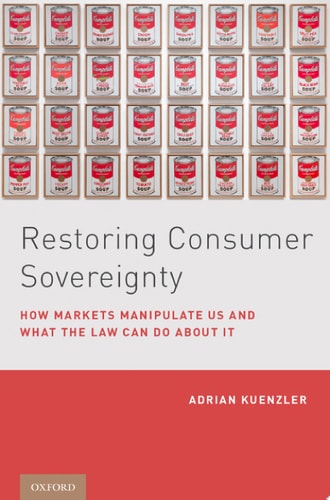
Restoring Consumer Sovereignty: How Markets Manipulate Us and What the Law Can Do About It
0
0
As an Amazon Associate and affiliate partner, Menrva Books earns from qualifying purchases. Learn more
Author Description
In today's highly concentrated marketplaces, social and cultural values--such as the lifestyle connotations that manufacturers and sellers confer upon their goods--often shape consumers' prior beliefs and attitudes and affect the weight given to new information by consumers who make purchasing decisions in the marketplace. Such consumer goods present the largely unexplored problem of contemporary market regulatory theory according to which an increased amount of product differentiation has rendered everyday purchasing decisions such as the choice between an iPhone or a Samsung Galaxy Note as much a matter of personal identity rather than merely one of tangible product attributes. The basic challenge for market regulators and courts in such an environment is to make markets work effectively by providing a more efficient exchange of information about consumer preferences relating to tangible product features, functions, and quality.This book demonstrates that improved legal policy can assist consumers and increase market efficiency. It acknowledges that once particular beliefs held by consumers have become culturally or socially entrenched, they are very difficult to change. What is more, changing such beliefs is no longer simply a matter of educating people through the provision of additional information. Developing a novel framework through a detailed analysis of case law relating to consumer goods markets, this book delivers an accessible introduction to the law and economics of consumer decision-making, and a forceful critique of contemporary market regulatory policy.
Menrva's Summary
THE THESIS
How can legal policy be restructured to protect consumer sovereignty when modern markets manipulate purchasing decisions through social and cultural identity? Adrian Kuenzler, a legal scholar, examines the intersection of behavioral economics and regulatory law to address the limitations of traditional information-based market policies. He argues that because product differentiation now targets personal identity rather than just tangible attributes, regulators must move beyond simple disclosure requirements to ensure market efficiency.
THE SCOPE MAP
What You Will Find
- Analysis of case law regarding consumer goods markets.
- A framework for evaluating the impact of social and cultural values on purchasing behavior.
- Critique of contemporary regulatory policies that rely solely on information provision.
Scope Limits
- The text does not provide a comprehensive guide to international consumer protection laws outside of the analyzed jurisdictions.
- It does not offer a psychological manual for individual consumers to resist marketing tactics.
THE AUTHORITY PERSPECTIVE
Experts identify this work as a significant contribution to the intersection of law and behavioral economics, noting its rigorous approach to modern market dynamics. Readers frequently highlight the academic density of the prose, which serves as a specialized resource for legal practitioners and policy analysts.
Page Count:
360
Publication Date:
2017-09-15
Publisher:
Oxford University Press
ISBN-10:
0190698578
ISBN-13:
9780190698577
Economics
Law
Antitrust Law
Consumer protection
Intellectual Property
Public Policy
Professional Career & Trade
Community Tags
Similar Books