Antitrust and Patent Law
0
0
As an Amazon Associate and affiliate partner, Menrva Books earns from qualifying purchases. Learn more
Author Description
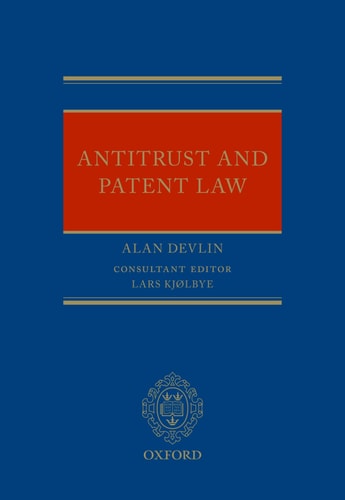
Patents lie at the heart of modern competition policy. In the new economy, firms use them variously to protect their R&D, to bolster their market positions, and to exclude rivals. Antitrust enforcers thus scrutinize patentees to ensure that they do not use their intellectual-property rights to suppress competition. Today's antitrust lawyers must therefore navigate intellectual-property issues and advise clients on the procurement and assertion of patents. It is no easy task. In granting exclusive rights, patents have an uneasy relationship with competition law, which struggles in turn to apply policies developed in bricks and mortar industries to the world of technology. This book explores the acquisition and use of patents under the law of the world's two most important antitrust regimes: the United States and the European Union. It examines antitrust rules governing technology transfer, standard-essential technologies, patent aggregation, open and closed systems, coercive licensing terms that amount to misuse, evergreening tactics in the pharmaceutical industry like 'paying for delay', and patentee immunity in suing for infringement. To contextualize that analysis, the book explores the theoretical relationship between patents and competition law, addresses the U.S. 'patent crisis', the move towards unitary patents in Europe, and differences between the US and EU competition regimes. Further, the book explores idiosyncrasies governing the core antitrust questions of market definition, market power, and anticompetitive conduct in the patent setting. In doing so, the book allows those who practice, enforce, teach, or study competition law to understand the subtleties of this fascinating subject.
Menrva's Summary
THE THESIS
How do antitrust regimes in the United States and the European Union reconcile the exclusive rights granted by patents with the mandates of competition law? Alan Devlin, a legal scholar specializing in competition policy, provides a comprehensive analysis of the intersection between intellectual property and antitrust enforcement. The book utilizes a comparative framework to evaluate how these two major jurisdictions manage the tension between protecting innovation and preventing the suppression of market competition.
THE SCOPE MAP
What You Will Find
- Comparative analysis of US and EU antitrust frameworks regarding patent acquisition and enforcement.
- Examination of technology transfer, standard-essential technologies, and patent aggregation.
- Discussion of pharmaceutical industry practices such as 'pay-for-delay' and patentee immunity.
- Theoretical exploration of market definition and market power within technology-driven sectors.
Scope Limits
- The text focuses primarily on the US and EU, excluding detailed analysis of emerging market antitrust regimes.
- It does not serve as a general primer on patent law, assuming a baseline understanding of intellectual property principles.
THE AUTHORITY PERSPECTIVE
Legal practitioners and academics frequently cite this work as a critical resource for navigating the complexities of modern competition policy in the technology sector. Experts highlight the book's ability to synthesize dense regulatory theory with practical applications for antitrust enforcement.
Page Count:
527
Publication Date:
2016-01-01
Publisher:
OUP Oxford
ISBN-10:
0191044830
ISBN-13:
9780191044830
Economics
Professional Career & Trade
Intellectual Property
Competition Policy
Antitrust Law
Patent Law
Law