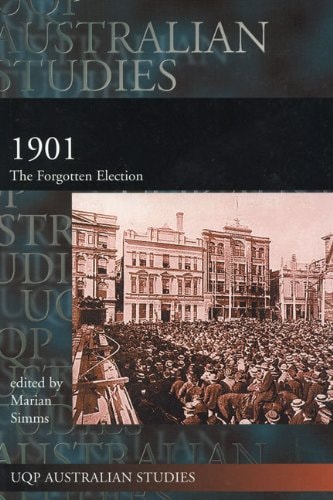
1901 The Forgotten Election
0
0
As an Amazon Associate and affiliate partner, Menrva Books earns from qualifying purchases. Learn more
Author Description
Examining the state of Australian democracy in 1901, this account demonstrates how the election was managed in all six of the country's states. South Australia was the paradise of liberalism, Queensland and the West scored low on political trust and discriminated against Aborigines and Pacific Islanders, New South Wales and Victoria had longer histories and instited on identity papers for voters, and Tasmania experimented with proportional representation. All leaders supported a White Austrtalia Policy. Political parties still in their infancy were forced to develop formal rules and preselection procedures for the election. Labour was strongest in New South Wales, South Australia and Queensland. There were few self-proclaimed conservatives and the forces of liberalism were largely split into Free Traders and Protectionists. The election resulted in the 'three elevenses' described by Deakin. However, had the result been Free Trade rather than Protectionist in a mere handful of seats, then the Australian settlement--Protection, Arbitration and White Australia--could have looked very different.
Menrva's Summary
THE THESIS
The 1901 Australian federal election, a pivotal moment in the nation's nascent democracy, was shaped by vastly different political landscapes and practices across its six states. The election navigated the unique challenges of each state, from South Australia's liberal paradise to New South Wales and Victoria's identity paper requirements, while Queensland and Western Australia exhibited lower political trust and discriminatory practices. The nascent political parties, including a strong Labour presence in certain states, were compelled to establish formal rules and preselection procedures. The dominant ideological divide was between Free Traders and Protectionists, with all leaders ultimately supporting the White Australia Policy, a policy that, along with Protection and Arbitration, could have been significantly altered by a different electoral outcome in a few key seats.
THE SCOPE MAP
- Analysis of the 1901 Australian federal election across all six states.
- Examination of the political climate and democratic practices in South Australia, Queensland, Western Australia, New South Wales, Victoria, and Tasmania.
- Discussion of discriminatory practices against Aborigines and Pacific Islanders in Queensland and Western Australia.
- Details on voter identification requirements in New South Wales and Victoria.
- Exploration of Tasmania's experimental use of proportional representation.
- The influence of the White Australia Policy on all state leaders.
- The development of formal rules and preselection procedures for emerging political parties, including Labour.
- The ideological split between Free Traders and Protectionists and its impact on the election's outcome.
THE AUTHORITY PERSPECTIVE
This historical account meticulously details the complexities of Australia's first federal election in 1901, highlighting the distinct political environments and practices within each state. The author demonstrates how the election's outcome, particularly the balance between Free Traders and Protectionists, could have fundamentally altered the foundational policies of the new nation. The book's focus on the state-by-state management of the election and the nascent development of political parties provides a granular view of Australian democracy at its inception. The analysis underscores the critical role of a few key seats in shaping the 'Australian settlement' of Protection, Arbitration, and White Australia.
Page Count:
294
Publication Date:
2001-01-01
Publisher:
University of Queensland Press
ISBN-10:
0702233021
ISBN-13:
9780702233029
Non-Fiction
History
Political History
Elections
Democracy
Australian History
Community Tags
Similar Books