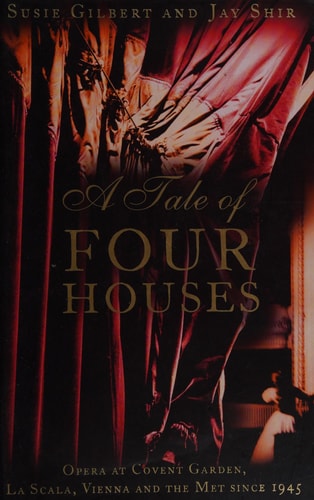
A Tale of Four Houses: Opera at Covent Garden, La Scala, Vienna and the Met Since 1945
0
0
As an Amazon Associate and affiliate partner, Menrva Books earns from qualifying purchases. Learn more
Author Description
Looking at four very different opera houses, this book tells the tales of the eccentric talents that made them immortal. An entertaining history of the four big opera houses - Milan, Vienna, the New York Met and Covent Garden - that illuminates major developments in opera both musically and in terms of stage interpretation. From the post-war reconstruction of opera houses to the influence of colourful personalities such as Karajan and Visconti, Callas as media-devil-cum-idol, Solti, Domingo, Pavarotti, Price and Sutherland, and finally the wide accessibility and popularity of opera today and the increasing financial pressures it faces. Susan Gilbert introduces enthralling personalities, and through them the scandals, the money, the media skirmishes and the drama that provide fascinating insights into the world of opera behind the scenes. Through the characters of the drama - the singers, conductors, directors and managers - Susan Gilbert captures that larger-than-life quality of the opera that has provided so many people with a sense of wonder and joy over the years.
Menrva's Summary
THE THESIS
This book investigates the post-1945 evolution of four preeminent global opera houses, questioning how the interplay of eccentric personalities, financial pressures, and artistic innovation shaped their modern identities. Susan Gilbert utilizes a biographical and historical framework to document the institutional trajectories of Covent Garden, La Scala, the Vienna State Opera, and the Metropolitan Opera. By focusing on the conductors, singers, and managers who defined these spaces, the author maps the transition of opera from a post-war reconstruction project to a globally accessible, media-driven cultural phenomenon.
THE SCOPE MAP
What You Will Find
- Comparative institutional histories of Covent Garden, La Scala, Vienna, and the Metropolitan Opera since 1945.
- Analysis of the influence exerted by key figures including Herbert von Karajan, Luchino Visconti, Maria Callas, and Luciano Pavarotti.
- Examination of the shift in stage interpretation and musical standards during the latter half of the 20th century.
- Discussion of the economic realities and media dynamics that dictate the contemporary opera landscape.
THE AUTHORITY PERSPECTIVE
The text provides a comprehensive, character-driven overview of the institutional challenges and artistic triumphs defining the world's most significant opera houses. Its focus on the intersection of individual ambition and organizational history offers a clear, accessible entry point for readers interested in the administrative and creative mechanics of high-level opera production.
Page Count:
976
Publication Date:
2000-01-01
Publisher:
Harper Collins
ISBN-10:
0002558203
ISBN-13:
9780002558204
Music
History
Biography
Opera
Music
Community Tags
Similar Books