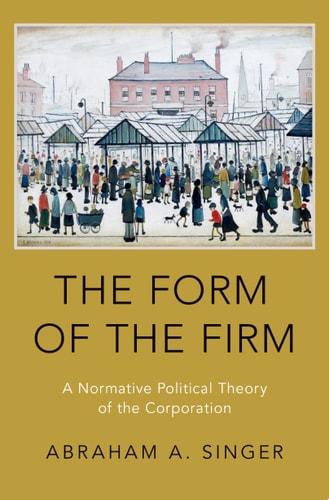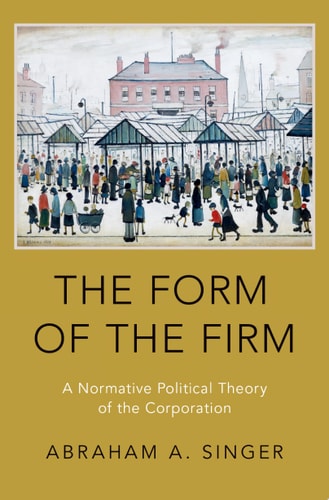
The Form of the Firm: A Normative Political Theory of the Corporation
0
0
As an Amazon Associate and affiliate partner, Menrva Books earns from qualifying purchases. Learn more
Author Description
The Form of the Firm unveils the nature of the corporation as it exists in modern liberal societies.What are we to make of the power that corporations wield over people in modern society? Is such power legitimate? Many think so. To many businessmen and economists, as well as the general public, firms are purely private and economic entities, justified in using all legal means to maximize profit.In The Form of the Firm, Abraham Singer contends that such a view rests on a theoretical foundation that, while quite subtle, is deeply flawed. Contrary to the conventional wisdom, corporations are not natural outgrowths of the free market. Instead, Singer invites us to see corporations as political institutions that correct market inefficiencies through mechanisms normally associated with government -hierarchy, power, and state-sanctioned authority. Corporations exist primarily to increase economic efficiency, but they do this in ways that distinguish them from the markets in which they operate. Corporations serve economic ends, but through political means. Because of this, Singer argues that they also must be structured and obliged to uphold the social and political values that enable their existence and smooth-running in the first place: individual autonomy, moral and social equality, and democratic norms and institutions.A profound and timely rethinking of what a corporation actually is and how power within it ought to be structured and exercised, The Form of the Firm will reshape our understanding of political theory, corporate governance, corporate law, and business ethics.
Menrva's Summary
THE THESIS
This book investigates whether the power wielded by modern corporations is legitimate when viewed through the lens of normative political theory. Abraham A. Singer, an expert in business ethics and political philosophy, challenges the conventional view that firms are purely private economic entities. He argues that corporations function as political institutions that utilize state-sanctioned authority and hierarchy to correct market inefficiencies, necessitating a reevaluation of their obligations to democratic values and individual autonomy.
THE SCOPE MAP
What You Will Find
- A political theory framework for analyzing corporate structure
- An analysis of the intersection between market efficiency and political authority
- Arguments regarding the application of democratic norms to private firms
Scope Limits
- The text does not provide a practical legal handbook for corporate compliance
- It does not focus on empirical financial performance metrics or stock market analysis
THE AUTHORITY PERSPECTIVE
Scholars and practitioners in the field of business ethics identify this work as a significant contribution to the normative understanding of the firm. Readers frequently note the academic density of the prose, which is intended for those familiar with political philosophy and corporate law.
Page Count:
310
Publication Date:
2018-01-01
Publisher:
Oxford University Press
ISBN-10:
0190698365
ISBN-13:
9780190698362
Philosophy
Economics
Corporate governance
Business Ethics
Political Theory
Professional Career & Trade
Community Tags
Similar Books