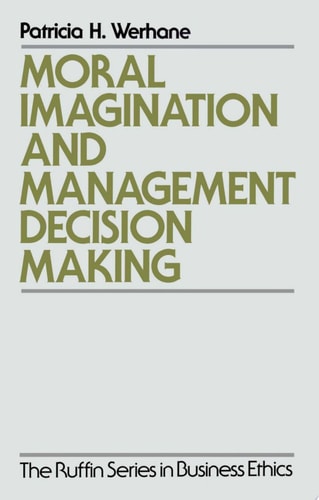
Moral Imagination and Management Decision-Making
0
0
As an Amazon Associate and affiliate partner, Menrva Books earns from qualifying purchases. Learn more
Author Description
Why do good people do ethically questionable things? Why do reputable businesses ignore the harmful consequences of their actions? These questions continue to challenge philosophers, legal scholars, and corporate leaders. In this pathbreaking book, Patricia Werhane sets forth a model that explains ethical failings in business and shows how to transcend them.Deleterious corporate actions are often attributed to simple greed, and regulations have traditionally been enacted to counter them. But Werhane argues that most corporate managers are not without moral sensibilities, nor are they motivated primarily by greed or self-interest. Indeed, companies themselves often attempt to improve ethical behavior-most American companies today have values statements, and ethics training is widespread-but applying moral principles to practical decision-making has not been entirely successful.What is missing, according to Werhane, is a highly developed moral imagination that enables managers and the companies they run to be aware of, evaluate, and change the mental models that often constrict business behavior. The development of moral imagination is not identified merely with increased sensitivity to the existence of ethical issues in business. It includes awareness of the mind-sets that govern managerial and corporate decision-making, the development of reasoning skills to evaluate and moderate these mind-sets, and creativity to ponder viable alternative solutions to what appear to be insoluble economic dilemmas.Unique in its sophisticated application of ethical reasoning to real day-to-day business problems, this book points the way to the exemplary moral leadership that will enable companies to flourish in the complex global economies of the twenty-first century.
Menrva's Summary
THE THESIS
This book investigates why ethical failures persist in corporate environments despite the presence of moral sensibilities and formal ethics training. Patricia H. Werhane, a prominent scholar in business ethics, argues that the primary obstacle to ethical corporate behavior is not inherent greed, but rather the rigid mental models that constrain managerial decision-making. She proposes the development of 'moral imagination'—a cognitive and creative framework—as the necessary tool for managers to identify, evaluate, and transcend these limiting mind-sets to achieve more responsible outcomes.
THE SCOPE MAP
What You Will Find
- A theoretical framework for moral imagination in professional settings
- Analysis of the psychological and structural constraints on corporate decision-making
- Methodologies for evaluating and moderating existing managerial mind-sets
- Strategies for creative problem-solving in complex economic dilemmas
THE AUTHORITY PERSPECTIVE
Experts recognize this work as a foundational text for integrating philosophical inquiry into practical business management. Readers frequently note the academic density of the prose, which serves as a rigorous guide for those seeking to bridge the gap between ethical theory and corporate practice.
Page Count:
160
Publication Date:
1999-03-18
Publisher:
Oxford University Press
ISBN-10:
019512569X
ISBN-13:
9780195125696
Philosophy
Corporate governance
Moral and ethical aspects
Management
Decision Making
Business Ethics
Community Tags
Similar Books