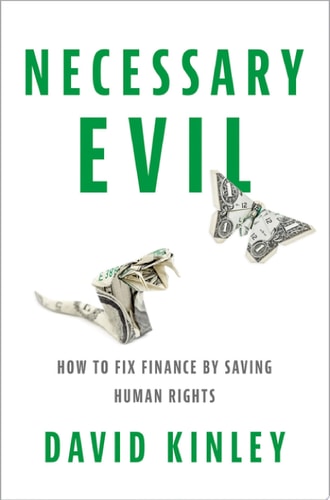
Necessary Evil: How to Fix Finance by Saving Human Rights
0
0
As an Amazon Associate and affiliate partner, Menrva Books earns from qualifying purchases. Learn more
Author Description
Finance is the evil we cannot live without. It governs almost every aspect of our lives and has the power to liberate as well as enslave. With the world's total financial assets--valued at a staggering $300 trillion--being four times larger than the combined output of all the world's economies, there is, apparently, plenty to go around. Yet, while proponents of finance-driven capitalism point to the trickle-down effect as its contribution to wealth redistribution, there are still nearly a billion people across the globe existing on less than $2 a day; 14 percent of Americans are living below the official poverty line; and disparities in wealth equality everywhere have reached unprecedented levels. Evidently a trickle is not enough. How can this be when so much wealth abounds, and when finance is supposedly chastened and reformed after its latest global crisis? How, especially, can it be in an age when human rights are more loudly proclaimed than ever before? Can the financial sector be made to shoulder more of the burden of spreading wealth, reducing poverty, and protecting rights? And if so, what role can human rights play in making it happen? In answering these questions, David Kinley draws on a vast array of material from bankers, economists, lawyers, and politicians, as well as human rights activists, philosophers, historians and anthropologists, alongside his own experiences working in the field. Necessary Evil shows how finance can shed its conceit, return to its role as the economy's servant not its master, and regain the public trust and credibility it has so spectacularly lost over the past decade--all by helping human rights, not harming them.
Menrva's Summary
THE THESIS
This book investigates whether the global financial sector can be reformed to prioritize human rights and wealth redistribution rather than serving as an autonomous, wealth-concentrating force. David Kinley, a professor and expert in human rights law, synthesizes perspectives from economists, bankers, and activists to argue that finance must return to its role as a servant of the economy. He proposes a framework where financial institutions are held accountable for their impact on global poverty and inequality through the lens of human rights obligations.
THE SCOPE MAP
What You Will Find
- Analysis of the $300 trillion global financial asset market.
- Examination of the disconnect between financial growth and poverty reduction.
- Interdisciplinary synthesis of legal, economic, and anthropological perspectives.
- Proposed mechanisms for integrating human rights standards into financial regulation.
Scope Limits
- Does not provide a technical manual for individual investment strategies.
- Does not offer a comprehensive history of every global financial crisis.
THE AUTHORITY PERSPECTIVE
Experts and readers frequently note the book's success in bridging the gap between abstract human rights discourse and the practical realities of global finance. It is widely regarded as a significant contribution for those seeking to understand the intersection of international law and economic policy.
Page Count:
284
Publication Date:
2018-01-01
Publisher:
Oxford University Press
ISBN-10:
019069114X
ISBN-13:
9780190691141
Economics
Finance
Social justice
Professional Career & Trade
Globalization
Human rights
Economics history
Community Tags
Similar Books