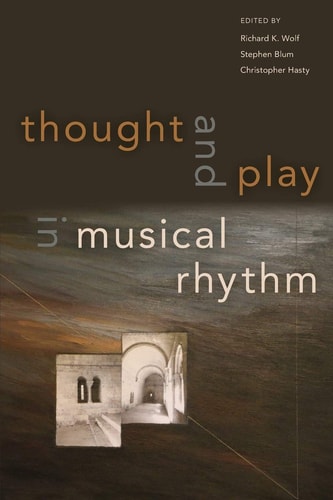
Thought and Play in Musical Rhythm
0
0
As an Amazon Associate and affiliate partner, Menrva Books earns from qualifying purchases. Learn more
Author Description
Thought and Play in Musical Rhythm offers new understandings of musical rhythm through the analysis and comparison of diverse repertoires, performance practices, and theories as formulated and transmitted in speech or writing. Editors Richard K. Wolf, Stephen Blum, and Christopher Hasty address a productive tension in musical studies between universalistic and culturally relevant approaches to the study of rhythm. Reacting to commonplace ideas in (Western) music pedagogy, the essays explore a range of perspectives on rhythm: its status as an "element" of music that can be usefully abstracted from timbre, tone, and harmony; its connotations of regularity (or, by contrast, that rhythm is what we hear against the grain of background regularity); and its special embodiment in percussion parts. Unique among studies of musical rhythm, the collection directs close attention to ways performers and listeners conceptualize aspects of rhythm and questions many received categories for describing rhythm. By drawing the ear and the mind to tensions, distinctions, and aesthetic principles that might otherwise be overlooked, this focus on local concepts enables the listener to dispel assumptions about how music works "in general." Readers may walk away with a few surprises, become more aware of their assumptions, and/or think of new ways to shock their students out of complacency.
Menrva's Summary
THE THESIS
This collection investigates how musical rhythm is conceptualized, performed, and theorized across diverse global traditions, challenging the dominance of Western pedagogical abstractions. Editors Richard K. Wolf, Stephen Blum, and Christopher Hasty curate a series of essays that examine the tension between universal rhythmic theories and culturally specific practices. By analyzing how performers and listeners articulate their understanding of time and movement, the contributors provide a framework for questioning standard musicological categories.
THE SCOPE MAP
What You Will Find
- Comparative analysis of diverse musical repertoires and performance practices
- Critiques of Western music pedagogy regarding rhythm as an isolated element
- Examination of the relationship between percussion, timbre, and structural regularity
Scope Limits
- Does not provide a singular, unified theory of rhythm
- Avoids exhaustive historical surveys in favor of focused conceptual case studies
THE AUTHORITY PERSPECTIVE
Scholars and music theorists frequently cite this work for its ability to bridge the gap between ethnomusicological fieldwork and formal music theory. The text is noted for its academic density and its utility in challenging conventional pedagogical assumptions within university music departments.
Page Count:
456
Publication Date:
2019-11-08
Publisher:
Oxford University Press
ISBN-10:
0190841494
ISBN-13:
9780190841492
Music theory
Music African
Academic
Musicology
Performance Studies
Rhythm
Community Tags
Similar Books