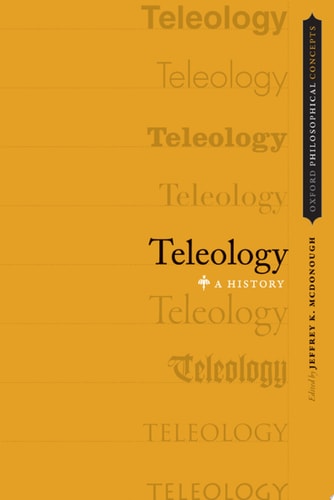
Teleology: A History
0
0
As an Amazon Associate and affiliate partner, Menrva Books earns from qualifying purchases. Learn more
Author Description
Teleology is the belief that some things happen, or exist for the sake of other things. It is the belief that, for example, salmon swim upstream in order to spawn, and that bears have claws for the sake of catching fish. This volume takes up the intuitive yet puzzling concept of teleology as it has been treated by philosophers from ancient times to the present day. It includes nine main chapters centered on the treatment of teleology in Plato, Aristotle, the Islamic medieval tradition, the Jewish medieval tradition, the Latin medieval tradition, the early modern era, Kant, Hegel, and contemporary philosophy. Each chapter probes central questions such as: is teleology inherent in its subjects or is it imposed on them from the outside? Does teleology necessarily involve intentionality, that is, a subject's cognizing some end, goal, or purpose? What is the scope of teleology? Is it, for example, applicable to elements and animals, or only to rational beings? Finally, is teleology explanatory? When we say that salmon swim upstream in order to spawn, have we explained why they swim upstream? When we say that bears have claws for catching fish, have we explained why bears have claws? The philosophical discussions of the main chapters are enlivened and contextualized by four reflection pieces exploring the implications of teleology in medicine, art, poetry, and music.
Menrva's Summary
THE THESIS
This volume investigates the historical development and philosophical legitimacy of teleology, the concept that entities or events exist for the sake of specific ends. Jeffrey K. McDonough, a scholar specializing in early modern philosophy, curates a collection of essays that examine how thinkers from antiquity to the contemporary era have grappled with the nature of purpose, intentionality, and explanation in the natural world. The text provides a rigorous framework for evaluating whether teleological claims function as valid scientific explanations or merely as heuristic impositions on physical phenomena.
THE SCOPE MAP
What You Will Find
- Historical analysis of teleological thought across nine distinct periods including Platonic, Aristotelian, medieval, and modern traditions.
- Critical examination of the relationship between intentionality and goal-directed behavior.
- Interdisciplinary reflection pieces applying teleological concepts to medicine, art, poetry, and music.
Scope Limits
- The text does not provide an exhaustive survey of every minor philosophical school but focuses on major historical shifts.
- It does not offer a definitive resolution to the debate between teleological and mechanistic explanations in modern biology.
THE AUTHORITY PERSPECTIVE
Experts identify this volume as a comprehensive resource for students and scholars interested in the evolution of teleological concepts. Readers frequently note the academic density of the prose, which is well-suited for advanced philosophical study and historical research.
Page Count:
314
Publication Date:
2020-01-01
Publisher:
Oxford University Press
ISBN-10:
0190845732
ISBN-13:
9780190845735
Philosophy
Non-Fiction
Philosophy history
Teleology
Academic
History & Surveys
Metaphysics
Community Tags
Other Editions(2)
Similar Books