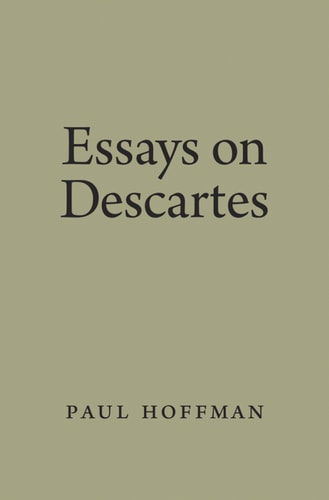
Essays on Descartes
Author Description
This is a collection of Paul Hoffman's wide-ranging essays on Descartes composed over the past twenty-five years. The essays in Part I include his celebrated "The Unity of Descartes' Man," in which he argues that Descartes accepts the Aristotelian view that soul and body are related as form to matter and that the human being is a substance; a series of subsequent essays elaborating on this interpretation and defending it against objections; and an essay on Descartes' theory of distinction. In the essays in Part II he argues that Descartes retains the Aristotelian theory of causation according to which an agent's action is the same as the passion it brings about, and explains the significance of this doctrine for understanding Descartes' dualism and physics. In the essays in Part III he argues that Descartes accepts the Aristotelian theory of cognition according to which perception is possible because things that exist in the world are also capable of a different way of existing in the soul, and he shows how this theory figures in Descartes' account of misrepresentation and in the controversy over whether Descartes is a direct realist or a representationalist. The essays in Part IV examine Descartes' theory of the passions of the soul: their definition; their effect on our happiness, virtue, and freedom; and methods of controlling them.
Menrva's Summary
THE THESIS
This collection investigates the extent to which René Descartes' philosophical framework remains rooted in Aristotelian traditions regarding substance, causation, and cognition. Paul Hoffman, a scholar specializing in early modern philosophy, compiles twenty-five years of research to challenge standard interpretations of Cartesian dualism. He argues that Descartes' work is more continuous with Scholastic and Aristotelian thought than is typically acknowledged in modern readings.
THE SCOPE MAP
What You Will Find
- Analysis of the soul-body relationship as form and matter
- Examination of the Aristotelian theory of causation in Cartesian physics
- Investigation into the theory of cognition and representationalism
- Studies on the definition and control of the passions of the soul
Scope Limits
- Does not provide a comprehensive biography of Descartes
- Does not cover the entirety of Descartes' mathematical or scientific contributions outside of their philosophical implications
THE AUTHORITY PERSPECTIVE
Scholars frequently cite this collection as a rigorous intervention in Cartesian studies, particularly regarding the author's defense of the Aristotelian influence on Descartes' substance dualism. Readers note the high level of academic density and the specialized nature of the arguments presented.
Page Count:
294
Publication Date:
2009-01-01
Publisher:
Oxford University Press
ISBN-10:
0190295732
ISBN-13:
9780190295738
Philosophy
History & Surveys
Metaphysics
Epistemology
Academic
Philosophy history
Community Tags
Similar Books