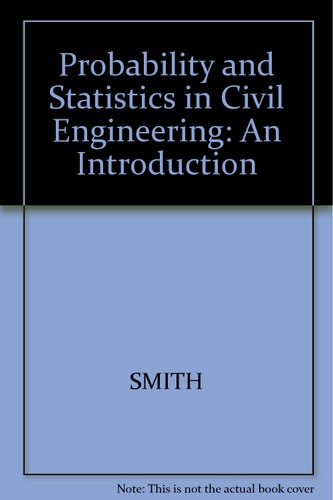
Probability and Statistics in Civil Engineering: An Introduction
0
0
As an Amazon Associate and affiliate partner, Menrva Books earns from qualifying purchases. Learn more
Author Description
The application of statistics to civil engineering design is a new and developing field, and the growing acceptance of limit state design is encouraging the use of probability theory for determining values. A further development is the use of the reliability index in geotechnical design, now becoming recognised as a powerful alternative to the use of partial safety factors. This book presents a straightforward summary of the most important aspects of statistics and probability theory that are relevant in civil engineering, particularly in the field of soil mechanics.
Menrva's Summary
THE THESIS
This text investigates the application of probability theory and statistical methods to civil engineering design, specifically addressing the transition toward limit state design and reliability-based geotechnical analysis. G. N. Smith provides a technical overview of how statistical frameworks can replace traditional partial safety factors in structural and soil mechanics applications. The book serves as an introductory bridge for engineers seeking to integrate quantitative risk assessment into their design methodologies. By focusing on the practical utility of these mathematical tools, the author outlines a systematic approach to managing uncertainty in engineering projects.
THE SCOPE MAP
What You Will Find
- Statistical methods for civil engineering design
- Application of probability theory in soil mechanics
- Reliability index calculations as an alternative to partial safety factors
- Mathematical foundations for limit state design
THE AUTHORITY PERSPECTIVE
The subject matter points to a foundational, specialist text intended for students and practitioners transitioning into modern reliability-based design standards. Its focus on soil mechanics and geotechnical applications suggests a practical, methodology-driven approach to engineering mathematics.
Page Count:
244
Publication Date:
1986-01-01
Publisher:
Collins
ISBN-10:
000383154X
ISBN-13:
9780003831542
Mathematics
Civil Engineering
Geotechnical Engineering
Probabilities
Probability
Soil Mechanics
Statistics
Community Tags
Similar Books