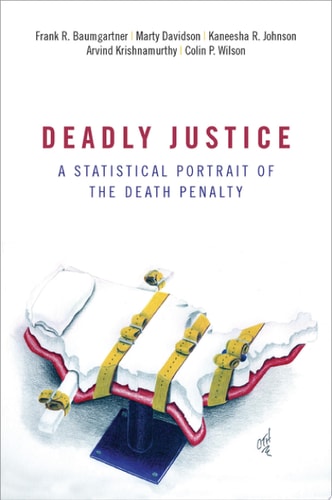
Deadly Justice: A Statistical Portrait of the Death Penalty
0
0
As an Amazon Associate and affiliate partner, Menrva Books earns from qualifying purchases. Learn more
Author Description
In 1976, the US Supreme Court ruled in Gregg v. Georgia that the death penalty was constitutional if it complied with certain specific provisions designed to ensure that it was reserved for the 'worst of the worst.' The same court had rejected the death penalty just four years before in the Furman decision because it found that the penalty had been applied in a capricious and arbitrary manner. The 1976 decision ushered in the 'modern' period of the US death penalty, setting the country on a course to execute over 1,400 inmates in the ensuing years, with over 8,000 individuals currently sentenced to die. Now, forty years after the decision, the eminent political scientist Frank Baumgartner along with a team of younger scholars (Marty Davidson, Kaneesha Johnson, Arvind Krishnamurthy, and Colin Wilson) have collaborated to assess the empirical record and provide a definitive account of how the death penalty has been implemented. Each chapter addresses a precise empirical question and provides evidence, not opinion, about whether how the modern death penalty has functioned. They decided to write the book after Justice Breyer issued a dissent in a 2015 death penalty case in which he asked for a full briefing on the constitutionality of the death penalty. In particular, they assess the extent to which the modern death penalty has met the aspirations of Gregg or continues to suffer from the flaws that caused its rejection in Furman. To answer this question, they provide the most comprehensive statistical account yet of the workings of the capital punishment system. Authoritative and pithy, the book is intended for both students in a wide variety of fields, researchers studying the topic, and--not least--the Supreme Court itself.
Menrva's Summary
THE THESIS
This book investigates whether the modern American death penalty system has successfully addressed the constitutional flaws of arbitrariness and capriciousness identified by the Supreme Court in the 1970s. The authors, led by political scientist Frank R. Baumgartner and a team of researchers, utilize extensive empirical data to evaluate the implementation of capital punishment since the 1976 Gregg v. Georgia decision. By focusing on statistical evidence rather than normative arguments, the text provides a rigorous assessment of whether the death penalty currently functions as a fair and consistent legal instrument.
THE SCOPE MAP
What You Will Find
- Comprehensive statistical analysis of capital punishment implementation since 1976
- Comparative data regarding the Furman and Gregg Supreme Court rulings
- Empirical evaluation of legal standards for the 'worst of the worst' offenders
- Quantitative assessment of systemic flaws in capital sentencing
Scope Limits
- The text prioritizes empirical data over philosophical or moral arguments regarding the death penalty
- The analysis is restricted to the modern era of the US death penalty following the 1976 Supreme Court ruling
THE AUTHORITY PERSPECTIVE
Experts and legal scholars recognize this work as a foundational empirical resource for understanding the mechanics of the modern capital punishment system. Readers frequently note the clarity of the statistical presentation, which makes complex legal and sociological data accessible to both academic researchers and general students of the law.
Page Count:
416
Publication Date:
2017-01-01
Publisher:
Oxford University Press
ISBN-10:
0190841567
ISBN-13:
9780190841560
Non-Fiction
Sociology
Criminology
Law
United States
Professional Career & Trade
Community Tags
Similar Books













Reader Comments
Share Your Thoughts
No comments yet. Be the first to share your thoughts!