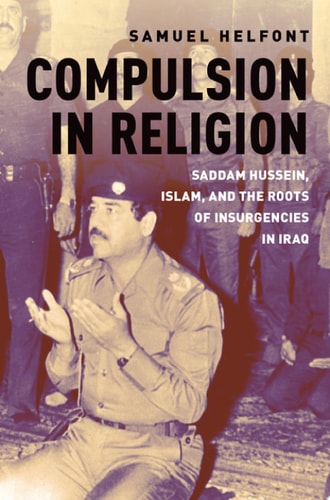
Compulsion in Religion: Saddam Hussein, Islam, and the Roots of Insurgencies in Iraq
0
0
As an Amazon Associate and affiliate partner, Menrva Books earns from qualifying purchases. Learn more
Author Description
Samuel Helfont draws on extensive research with Ba'thist archives to investigate the roots of the religious insurgencies that erupted in Iraq following the American-led invasion in 2003. In looking at Saddam Hussein's policies in the 1990s, many have interpreted his support for state-sponsored religion as evidence of a dramatic shift away from Arab nationalism toward political Islam. While Islam did play a greater role in the regime's symbols and Saddam's statements in the 1990s than it had in earlier decades, the regime's internal documents challenge this theory. The "Faith Campaign" Saddam launched during this period was the culmination of a plan to use religion for political ends, begun upon his assumption of the Iraqi presidency in 1979. At this time, Saddam began constructing the institutional capacity to control and monitor Iraqi religious institutions. The resulting authoritarian structures allowed him to employ Islamic symbols and rhetoric in public policy, but in a controlled manner. Saddam ultimately promoted a Ba'thist interpretation of religion that subordinated it to Arab nationalism, rather than depicting it as an independent or primary political identity.The point of this examination of Iraqi history, other than to correct the current understanding of Saddam Hussein's political use of religion throughout his presidency, is to examine how Saddam's controlled use of religion was dismantled during the US-Iraq war, and consequently set free extremists that were suppressed under his regime. When the American-led invasion destroyed the regime's authoritarian structures, it unwittingly unhinged the forces that these structures were designed to contain, creating an atmosphere infused with religion, but lacking the checks provided by the former regime. Groups such as the Sadrists, al-Qaida, and eventually the Islamic State emerged out of this context to unleash the insurgencies that have plagued post-2003 Iraq.
Menrva's Summary
THE THESIS
This book investigates whether Saddam Hussein’s promotion of religion in the 1990s represented a genuine ideological shift toward political Islam or a calculated authoritarian strategy to maintain state control. Samuel Helfont, a scholar specializing in Middle Eastern security and political history, utilizes declassified Ba'thist archives to challenge the prevailing narrative that the regime abandoned Arab nationalism. He argues that the 'Faith Campaign' was a continuation of long-standing efforts to institutionalize state control over religious discourse, rather than a surrender to Islamist ideology.
THE SCOPE MAP
What You Will Find
- Analysis of Ba'thist internal documents from 1979 to 2003.
- Examination of the institutional mechanisms used to monitor and regulate Iraqi religious organizations.
- Historical assessment of how the post-2003 power vacuum facilitated the rise of extremist groups like al-Qaida and the Islamic State.
Scope Limits
- The study does not provide a comprehensive biography of Saddam Hussein.
- The analysis focuses primarily on state-level policy and institutional structures rather than grassroots religious movements independent of the regime.
THE AUTHORITY PERSPECTIVE
Scholars and political analysts recognize this work as a significant contribution to the study of authoritarian regimes and the unintended consequences of state collapse. Readers frequently note the academic density of the prose and the author's meticulous reliance on primary source documentation to dismantle common misconceptions about Iraqi political history.
Page Count:
302
Publication Date:
2018-01-01
Publisher:
Oxford University Press
ISBN-10:
0190843330
ISBN-13:
9780190843335
History
Religion
Islam And Politics
Islam And State
Iraq
Military History
Religion and Politics
Middle Eastern
Community Tags
Similar Books