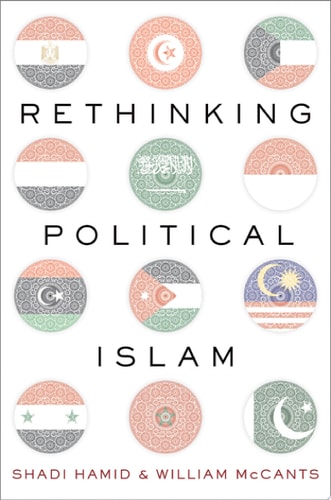
Rethinking Political Islam
0
0
As an Amazon Associate and affiliate partner, Menrva Books earns from qualifying purchases. Learn more
Author Description
For years, scholars hypothesized about what Islamists might do if they ever came to power. Now, they have answers: confusing ones. In the Levant, ISIS established a government by brute force, implementing an extreme interpretation of Islamic law. On the opposite end of the spectrum, Tunisia's Ennahda Party governed in coalition with two secular parties, ratified a liberal constitution, and voluntarily stepped down from power. In Egypt, the Muslim Brotherhood, the world's oldest Islamist movement, won power through free elections only to be ousted by a military coup. The strikingly disparate results of Islamist movements have challenged conventional wisdom on political Islam, forcing experts and Islamists to rethink some of their most basic assumptions.In Rethinking Political Islam, two of the leading scholars on Islamism, Shadi Hamid and William McCants, have gathered a group of leading specialists in the field to explain how an array of Islamist movements across the Middle East and Asia have responded. Unlike ISIS and other jihadist groups that garner the most media attention, these movements have largely opted for gradual change. Their choices, however, have been reshaped by the revolutionary politics of the region. The groups depicted in the volume capture the contradictions, successes, and failures of Islamism, providing a fascinating window into a rapidly changing Middle East. It is the first book to systematically assess the evolution of mainstream Islamist groups since the Arab uprisings and the rise of ISIS, covering 12 country cases. In each instance, contributors address key questions, including: gradual versus revolutionary approaches to change; the use of tactical or situational violence; attitudes toward the nation-state; and how ideology, religion, and political variables interact.For the first time in book form, readers will also hear directly from Islamist activists and leaders themselves, as they offer their own perspectives on the future of their movements.
Menrva's Summary
THE THESIS
This volume investigates how the diverse outcomes of Islamist movements across the Middle East and Asia have challenged established academic and political assumptions regarding the trajectory of political Islam. Editors Shadi Hamid and William McCants, both established scholars in the field of Middle Eastern politics, curate a collection of essays from leading specialists to analyze the evolution of mainstream Islamist groups. The work utilizes a comparative framework to examine how these movements have adapted their ideologies and strategies in the wake of the Arab uprisings and the emergence of extremist entities like ISIS.
THE SCOPE MAP
What You Will Find
- Comparative analysis of 12 distinct country cases across the Middle East and Asia.
- Examination of the tension between gradualist political approaches and revolutionary change.
- First-hand perspectives from Islamist activists and organizational leaders.
- Assessment of the interaction between religious ideology, state structures, and political variables.
Scope Limits
- The text focuses primarily on mainstream Islamist movements and does not provide an exhaustive history of jihadist organizations.
- The analysis is bounded by the post-Arab Spring political landscape and does not cover long-term historical developments prior to the 21st century.
THE AUTHORITY PERSPECTIVE
Experts identify this work as a significant contribution to the study of contemporary Islamist politics due to its systematic comparative approach. Readers frequently note the academic density of the prose, which is intended for students and professionals seeking a nuanced understanding of regional political shifts.
Page Count:
400
Publication Date:
2017-08-14
Publisher:
Oxford University Press
ISBN-10:
0190649208
ISBN-13:
9780190649203
History
Islam
Islamic Studies
Islam And Politics
Middle Eastern
International relations
International Security
Islamic Countries
Comparative Politics
Middle East
Community Tags
Other Editions(2)

Similar Books





Reader Comments
Share Your Thoughts
No comments yet. Be the first to share your thoughts!