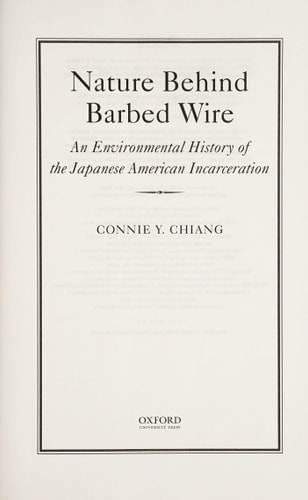
Nature Behind Barbed Wire: An Environmental History of the Japanese American Incarceration
0
0
As an Amazon Associate and affiliate partner, Menrva Books earns from qualifying purchases. Learn more
Author Description
The mass imprisonment of over 110,000 people of Japanese ancestry during World War II was one of the most egregious violations of civil liberties in United States history. Removed from their homes on the temperate Pacific Coast, Japanese Americans spent the war years in desolate camps in the nation's interior. Photographers including Ansel Adams and Dorothea Lange visually captured these camps in images that depicted the environment as a source of both hope and hardship. And yet the literature on incarceration has most often focused on the legal and citizenship statuses of the incarcerees, their political struggles with the US government, and their oral testimony.Nature Behind Barbed Wire shifts the focus to the environment. It explores how the landscape shaped the experiences of both Japanese Americans and federal officials who worked for the War Relocation Authority (WRA), the civilian agency that administered the camps. The complexities of the natural world both enhanced and constrained the WRA's power and provided Japanese Americans with opportunities to redefine the terms and conditions of their confinement. Even as the environment compounded their feelings of despair and outrage, the incarcerees also found that their agency in transforming and adapting to the natural world could help them survive and contest their incarceration. Japanese Americans and WRA officials negotiated the terms of confinement with each other and with a dynamic natural world.Ultimately, as Connie Chiang demonstrates, the Japanese American incarceration was fundamentally an environmental story.
Menrva's Summary
THE THESIS
This work investigates how the physical environments of incarceration camps fundamentally shaped the experiences, survival strategies, and power dynamics of Japanese Americans and War Relocation Authority officials during World War II. Connie Y. Chiang, a professor of history and environmental studies, utilizes archival records, government documents, and photographic evidence to reframe the history of mass incarceration. By shifting the analytical lens from purely legal and political frameworks to an environmental perspective, she argues that the landscape acted as both a tool of control and a site of agency for those imprisoned.
THE SCOPE MAP
What You Will Find
- Analysis of the diverse ecological settings of various War Relocation Authority camps.
- Examination of how camp infrastructure interacted with local climates and geography.
- Use of visual evidence from photographers such as Ansel Adams and Dorothea Lange.
- Documentation of how incarcerees transformed camp landscapes through gardening and agriculture.
Scope Limits
- The text does not provide a comprehensive legal history of the incarceration process.
- It does not focus on the post-war resettlement experiences of the incarcerees.
THE AUTHORITY PERSPECTIVE
Historians and scholars of the American West recognize this text as a significant contribution to the field of environmental history for its innovative intersectional approach. Readers frequently note the clarity of the prose and the depth of the research, which successfully bridges the gap between social history and ecological analysis.
Page Count:
328
Publication Date:
2018-09-04
Publisher:
Oxford University Press
ISBN-10:
0190842067
ISBN-13:
9780190842062
History
United States
Environmental History
American Studies
Human ecology
World War
Social Science
Einwanderer
Internierung
Japaner
Weltkrieg
Community Tags
Similar Books