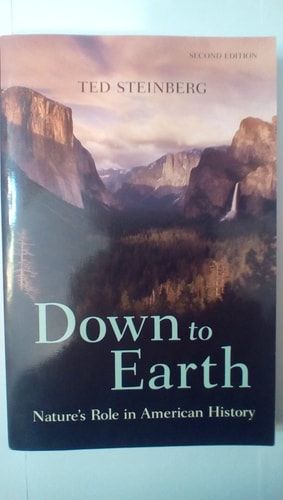
Down to Earth: Nature's Role in American History
0
0
As an Amazon Associate and affiliate partner, Menrva Books earns from qualifying purchases. Learn more
Author Description
In this ambitious and provocative text, environmental historian Ted Steinberg offers a sweeping history of the United States--a history that, for the first time, places the environment at the very center of the narrative. Now in a new edition, Down to Earth reenvisions the story of America "from the ground up." It reveals how focusing on plants, animals, climate, and other ecological factors can radically change the way that we think about the past. Examining such familiar topics as colonization, the industrial revolution, slavery, the Civil War, and the emergence of consumer culture, Steinberg recounts how the natural world influenced the course of human history. From the colonists' attempts to impose order on the land to modern efforts to sell the wilderness as a consumer good, he reminds readers that many critical episodes in U.S. history were, in fact, environmental events. The text highlights the ways in which Americans have attempted to reshape and control nature, from Thomas Jefferson's surveying plan, which divided the national landscape into a grid, to the transformation of animals, crops, and even water into commodities.In the second edition, Steinberg has thoroughly revised and updated the section on the twentieth century. He also introduces a timely new theme--the rise of the corporation. By addressing the ways in which nature functions in the world of big business, as well as the efforts by environmentalists to combat corporate power, Steinberg provides a richer understanding of consumerism.Down to Earth is ideal for courses in environmental history, environmental studies, urban studies, economic history, and American history. Passionately argued and thought provoking, this powerful text retells our nation's history with nature in the foreground--a perspective that will challenge our view of everything from Jamestown to McDonald's.
Menrva's Summary
THE THESIS
How does the integration of ecological factors and environmental change fundamentally alter the traditional narrative of United States history? Ted Steinberg, a prominent environmental historian, utilizes a multidisciplinary approach to reframe American history by placing the natural world at the center of human events. By examining the intersection of geography, climate, and biological resources with political and economic development, Steinberg argues that the American experience is inseparable from its environmental context. The text provides a comprehensive framework for understanding how land use, resource extraction, and corporate expansion have dictated the trajectory of the nation from the colonial era to the present day.
THE SCOPE MAP
What You Will Find
- Analysis of major historical periods including colonization, the industrial revolution, and the Civil War through an ecological lens.
- Examination of the commodification of natural resources such as water, crops, and animal populations.
- Discussion of the rise of corporate power and its specific impact on environmental policy and consumer culture.
- Evaluation of human attempts to impose geometric and bureaucratic order on the landscape, such as the Jeffersonian grid system.
THE AUTHORITY PERSPECTIVE
Scholars and educators frequently cite this text as a foundational work for integrating environmental studies into standard American history curricula. Readers often note the clarity of the prose, which makes complex ecological and economic arguments accessible to both undergraduate students and general history enthusiasts.
Page Count:
384
Publication Date:
2008-03-25
Publisher:
Oxford University Press
ISBN-10:
0195331826
ISBN-13:
9780195331820
Nature
History
American History
Economic History
United States
Environmental History
Human ecology
Human beings
Community Tags
Other Editions(2)
Similar Books



Reader Comments
Share Your Thoughts
No comments yet. Be the first to share your thoughts!