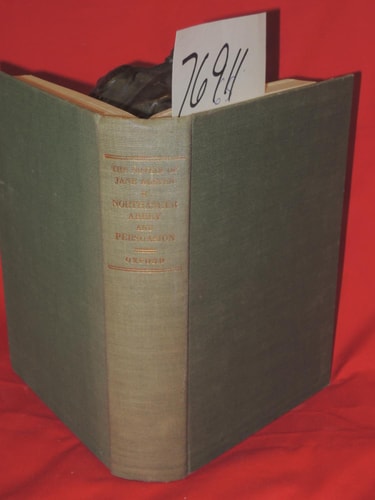
Northanger Abbey / Persuasion
0
0
As an Amazon Associate and affiliate partner, Menrva Books earns from qualifying purchases. Learn more
Author Description
With A to Z Classics, discover or rediscover all the classics of literature.Contains Active Table of Contents (HTML)In this spirited comedy of manners Catherine Morland, a plain, unspoiled small-town girl on holiday in Bath, meets and falls in love with Henry Tilney, a handsome young clergyman. Henry's father, believing Catherine to be wealthy, invites her to be a guest at Northanger Abby, the family's country estate. Catherine, who has read too many Gothic romances and who is possessed of too vivid an imagination, views the abbey as a house of nightmarish horror — an aspect of the book that gleefully parodies the fantastic Gothic romances by Ann Radcliffe and other popular writers of the period. An amusing assortment of misunderstandings and plot twists result in the satisfying romantic conclusion characteristic of the author’s works.First written in 1789-99, when Austen was in her early twenties, this novel, like Persuasion, did not see publication till 1818, in the winter after the author's death. Distinguished by its satirical wit, brilliant comedy, and complex but subtle views of human nature and morality, the book also presents a fine background picture of middle-class life in nineteenth-century England, with particularly good scenes in Bath, the fashionable watering place to which Austen's father, a clergyman himself, had retired. Northanger Abbey is a must-read for all Austen fans and students of English literature.
Menrva's Summary
THE PULSE
Catherine Morland, a naive young woman visiting Bath, finds her expectations of high society and romance challenged by her own overactive imagination and the social machinations of those around her. Catherine seeks to navigate the complex social hierarchies of the English gentry while harboring a deep fascination with the dramatic tropes of Gothic literature. Her primary obstacle is the disconnect between her fictionalized perception of reality and the pragmatic, often mercenary, motivations of the people she encounters. The narrative employs a third-person omniscient perspective to provide ironic commentary on the protagonist's internal state and the societal norms of the era.
INSIDE THE PAGES
- Satirical critique of the popular Gothic novel genre
- Detailed depiction of social customs in Regency-era Bath
- Use of irony to highlight the protagonist's lack of worldly experience
- Exploration of the intersection between literature and personal perception
- Focus on the economic realities of marriage and social standing
- Character-driven dialogue that reveals underlying class tensions
- Subversion of traditional romantic tropes and expectations
- Examination of the moral development of a young woman in transition
THE COLLECTIVE ECHO
This work is widely regarded as a foundational example of the comedy of manners, celebrated for its sharp wit and structural precision. Readers and critics frequently highlight the author's ability to balance a lighthearted parody of Gothic fiction with a serious examination of social morality. The narrative's enduring appeal stems from its nuanced characterization and the clever way it exposes the absurdities of human behavior. It remains a staple of English literature, consistently analyzed for its contribution to the development of the novel form.
Page Count:
380
Publication Date:
1973-09-03
Publisher:
HarperCollins Publishers
ISBN-10:
000424415X
ISBN-13:
9780004244150
Romance
Satire
Literature & Fiction
Comedy of Manners
Historical
classic
Community Tags
Similar Books