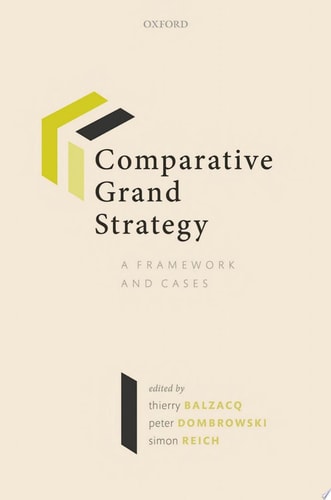
Comparative Grand Strategy
0
0
As an Amazon Associate and affiliate partner, Menrva Books earns from qualifying purchases. Learn more
Author Description
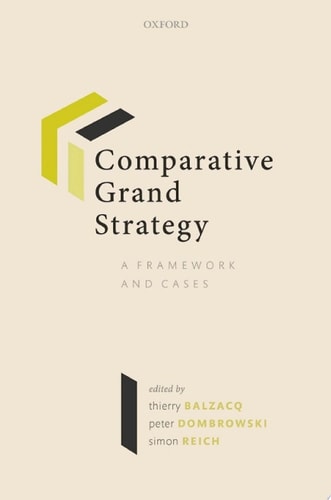
This Book Develops A New Approach In Explaining How A Nation's Grand Strategy Is Constituted, How To Assess Its Merits, And How Grand Strategies May Be Comparatively Evaluated Within A Broader Framework. The Volume Responds To Three Key Problems Common To Both Academia And Policymaking. First, The Literature On The Concept Of Grand Strategy Generally Focuses On The United States, Offering No Framework For Comparative Analysis. Indeed, Many Proponents Of Us Grand Strategy Suggest That The Concept Can Only Be Applied, At Most, To A Very Few Great Powers Such As China And Russia. Second, Characteristically It Remains Prescriptive Rather Than Explanatory, Ignoring The Central Conundrum Of Why Differing Countries Respond In Contrasting Ways To Similar Pressures. Third, It Often Understates The Significance Of Domestic Politics And Policymaking In The Formulation Of Grand Strategies - Emphasizing Mainly Systemic Pressures. This Book Addresses These Problems. It Seeks To Analyze And Explain Grand Strategies Through The Intersection Of Domestic And International Politics In Ten Countries Grouped Distinctively As Great Powers (the G5), Regional Powers (brazil And India) And Pivotal Powers Hostile To Each Other Who Are Able To Destabilize The Global System (iran, Israel, And Saudi Arabia). The Book Thus Employs A Comparative Framework That Describes And Explains Why And How Domestic Actors And Mechanisms, Coupled With External Pressures, Create Specific National Strategies. Overall, The Book Aims To Fashion A Valid, Cross-contextual Framework For An Emerging Research Program On Grand Strategic Analysis.
Menrva's Summary
THE THESIS
This book investigates how nations formulate grand strategies by proposing a new analytical framework that accounts for the intersection of domestic politics and international systemic pressures. The authors, Thierry Balzacq, Peter Dombrowski, and Simon Reich, leverage their expertise in international relations to address the lack of comparative tools in existing literature. By shifting the focus from purely prescriptive US-centric models to an explanatory approach, they seek to understand why different nations respond uniquely to similar global challenges.
THE SCOPE MAP
What You Will Find
- A comparative framework for analyzing grand strategy across ten distinct nations.
- Categorization of states into Great Powers (G5), Regional Powers (Brazil and India), and Pivotal Powers (Iran, Israel, and Saudi Arabia).
- An analysis of the interplay between internal domestic mechanisms and external geopolitical pressures.
Scope Limits
- The study does not provide a comprehensive history of every nation's foreign policy but focuses on the mechanics of strategic formulation.
- It does not attempt to predict future geopolitical outcomes but rather establishes a methodology for current and future research.
THE AUTHORITY PERSPECTIVE
Experts identify this volume as a significant contribution to the field of security studies for its attempt to move beyond the traditional US-centric bias in strategic analysis. Scholars frequently note that the text provides a rigorous, structured methodology that is useful for both academic researchers and policy practitioners.
Page Count:
312
Publication Date:
2019-01-01
Publisher:
Oxford University Press
ISBN-10:
0192577549
ISBN-13:
9780192577542
Geopolitics
International relations
Grand Strategy
Comparative Politics
Foreign Policy
Community Tags
Similar Books