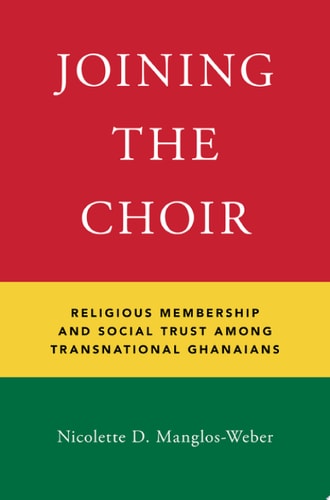
Joining the Choir: Religious Membership and Social Trust Among Transnational Ghanaians
0
0
As an Amazon Associate and affiliate partner, Menrva Books earns from qualifying purchases. Learn more
Author Description
Immigration and race are contentious issues in North America. As a result, immigrants from Ghana and other countries of West Africa confront major challenges in the social context of the United States, even as their experiences and accomplishments confound stereotypes. Religious congregations have often helped immigrants navigate the tricky waters of integration in the past; yet how do these particular black immigrants approach organized religion in light of their identities and aspirations? What are they looking for in religious membership, and how do they find it? In Joining the Choir, Nicolette D. Manglos-Weber takes a deeply personal look at the lives of a few central characters in Accra, Ghana and Chicago, Illinois, examining what religious membership means for them as Christians, transnational Ghanaians, and aspirational migrants. She sheds light on their search for people they can trust and their desires to transcend divisions of race, ethnicity, and nationality in the context of Evangelical Christianity. Her characters are complex, motivated, and adaptable people for whom religious membership answers some questions of integration and raises others. The stories of these migrants show how racial divides are subtly perpetuated within congregations in spite of hopes for religious-based assimilation. Yet they also reveal the potential of religious-based personal trust to bridge those divides, as an imaginative and symbolic leap of faith with the unknown stranger. Finally, their stories highlight the continuing role of religion as a portable basis of trust in the modern world, where more and more people live between nations.
Menrva's Summary
THE THESIS
This book investigates how transnational Ghanaian migrants utilize religious membership as a mechanism for building social trust and navigating the complexities of integration within the United States. Nicolette D. Manglos-Weber, a sociologist specializing in religion and migration, draws upon extensive ethnographic fieldwork conducted in both Accra, Ghana, and Chicago, Illinois. By analyzing the personal narratives of aspirational migrants, she argues that while religious congregations offer a framework for community, they simultaneously reflect and perpetuate existing racial and ethnic divisions.
THE SCOPE MAP
What You Will Find
- Comparative ethnographic analysis of religious communities in Accra and Chicago.
- Theoretical framework regarding the role of religion as a portable basis for trust.
- Examination of Evangelical Christianity as a site for both assimilation and social boundary maintenance.
Scope Limits
- The study focuses specifically on Ghanaian migrants and does not represent the experiences of all West African immigrant groups.
- The research does not provide a comprehensive policy analysis of immigration law, focusing instead on the sociological and interpersonal dimensions of migrant life.
THE AUTHORITY PERSPECTIVE
Scholars in the sociology of religion identify this work as a significant contribution to the study of transnational identity and institutional belonging. Readers frequently note the academic rigor of the qualitative methodology and the nuanced portrayal of how religious spaces function for modern migrants.
Page Count:
238
Publication Date:
2018-01-01
Publisher:
Oxford University Press
ISBN-10:
0190841060
ISBN-13:
9780190841065
Religion
Christianity
Chicago ill
Social Science
Immigration
Sociology
Community Tags
Similar Books